Singapore: The Architecture of Scarcity
What happens when an entire country's real-estate market has almost no room left to expand?
A city that cannot waste space
Singapore is not simply a city with expensive real estate. It is a country whose political, economic and architectural identity has been shaped by the permanent fact of scarcity. There is little hinterland, no wide suburban belt to absorb mistakes, no second metropolis to take pressure away from the centre. Every airport expansion, port relocation, housing estate, financial district, park, highway and shopping street has to compete for land inside the same small national frame.
That is why Singapore's property market is almost impossible to understand without understanding the state itself. In many cities, real estate is the outcome of private demand, land ownership and market cycles. In Singapore, real estate is also an instrument of government: a tool for social stability, economic positioning, population management and national survival.
The result is one of the most controlled property environments in the world. It is a place where public housing can shelter the majority of residents, where private apartments rank among Asia's most expensive assets, where office towers compete for global capital, and where green terraces and artificial waterfalls are not decoration but part of a deeper urban strategy: to make density feel liveable.
The state as the first developer
The starting point is housing. Singapore's public-housing system is not a marginal social programme. It is the backbone of the country's residential structure. Government sources state that more than one million HDB flats are home to about 80% of resident households, making public housing one of the country's defining institutions (Gov.sg, 2025).
This matters because Singapore did not leave its housing question to the private market alone. The state used housing to transform an overcrowded, fragmented port city into a planned home-owning society. Public flats became a way to resettle families, build household wealth, manage ethnic integration, secure political legitimacy and root citizens to the territory of the nation.
In that sense, Singapore's real estate market begins with a paradox. It is famous for luxury condos, financial towers and international capital, but its most important asset class is still public housing. The private market floats above a vast state-managed base. The price of a condominium is not only a function of global wealth. It is also shaped by how the state releases land, regulates credit, manages immigration, supplies HDB flats and cools excessive speculation.
Scarcity as policy, not accident
Many global cities have limited prime land. Singapore has limited everything. That constraint gives planning unusual power. The Urban Redevelopment Authority describes the Master Plan as the statutory land-use plan guiding Singapore's development over the medium term, and Master Plan 2025 sets the blueprint for the next 10 to 15 years (Urban Redevelopment Authority, 2025).
This is not merely zoning in the background. It is the visible operating system of the city. Scarcity is distributed, sequenced and monetised. Land is released through Government Land Sales. Districts are planned around transport, greenery and mixed use. Former industrial or port areas are gradually reimagined. Future coastlines are treated as economic, ecological and defensive infrastructure.
The market therefore does not operate on a blank canvas. It operates inside a national plan. That creates stability, but also a constant tension. If supply is too tight, prices rise and affordability becomes politically sensitive. If supply is too generous, land values weaken and household wealth may be affected. Singapore's real estate challenge is not simply to build more, but to build enough, in the right places, at the right speed.
Marina Bay: land made financial
No district explains Singapore's real estate logic better than Marina Bay. It is not just a skyline. It is reclaimed land turned into a balance sheet. URA notes that Singapore began an ambitious land reclamation project in 1971 in anticipation of growth in the existing city centre; by the late 1990s, Marina Bay covered around 360 hectares of prime development land (Urban Redevelopment Authority, n.d.).
That single fact changes the way one should read the city. Singapore did not wait for a financial district to emerge organically. It created the physical ground for one. The state manufactured a new urban frontier beside the old CBD, then used it to host offices, hotels, retail, convention space, entertainment, waterfront public realm and luxury housing.
This is why Marina Bay feels more deliberate than many financial districts. The roads, views, promenades, parks, towers and hotels are not a loose accumulation of private decisions. They are the product of a state that understood land as strategy. The city did not merely build upwards because land was scarce. It also built outwards, through reclamation, because scarcity could be engineered.
The global capital machine
Singapore's appeal to international investors is built on more than beauty. It offers rule of law, political stability, currency credibility, a strong banking system, deep family-office activity, corporate headquarters, excellent infrastructure and a strategic position between China, India, Southeast Asia and global finance.
CBRE's 2026 Singapore Real Estate Market Outlook places Singapore among the top three investment destinations in Asia Pacific in 2026, supported by a pipeline of investment-grade assets and sustained rental growth across key sectors (CBRE Singapore, 2026). CBRE's wider Asia Pacific outlook also points to offices regaining investor favour, with constrained supply supporting rental growth in markets such as Singapore (CBRE, 2026a).
This is the core of Singapore's investment case. Scarcity does not only make housing expensive. It also protects certain commercial assets from easy competition. A prime office tower in Singapore is not easily replicated. There is only so much CBD land, only so much Grade A stock, and only so much space that satisfies the requirements of banks, law firms, asset managers and technology companies.
The office market and the price of credibility
In a less controlled city, office demand can sometimes spill into broad speculative construction. In Singapore, supply is more carefully filtered. That can make the prime office market resilient, particularly when multinational occupiers compete for limited high-quality space.
CBRE reported in June 2026 that Singapore Grade A office rents had recorded a sixth consecutive quarter of rental growth, with scarcity of quality space increasingly shaping occupier behaviour and future developments scheduled for completion in 2028 or 2029 already attracting pre-commitment activity (CBRE, 2026b).
That dynamic is central to the city's financial real estate. Singapore's high rents are not simply a symptom of greed or prestige. They reflect the price of operating in a jurisdiction that global capital trusts. Companies pay for address, infrastructure, law, security, talent access and proximity to other institutions. In Singapore, office rent is partly the price of credibility.
The Majlis Newsletter
Continue reading with us. New essays on markets, pipelines and capital, delivered as they publish.
The green premium
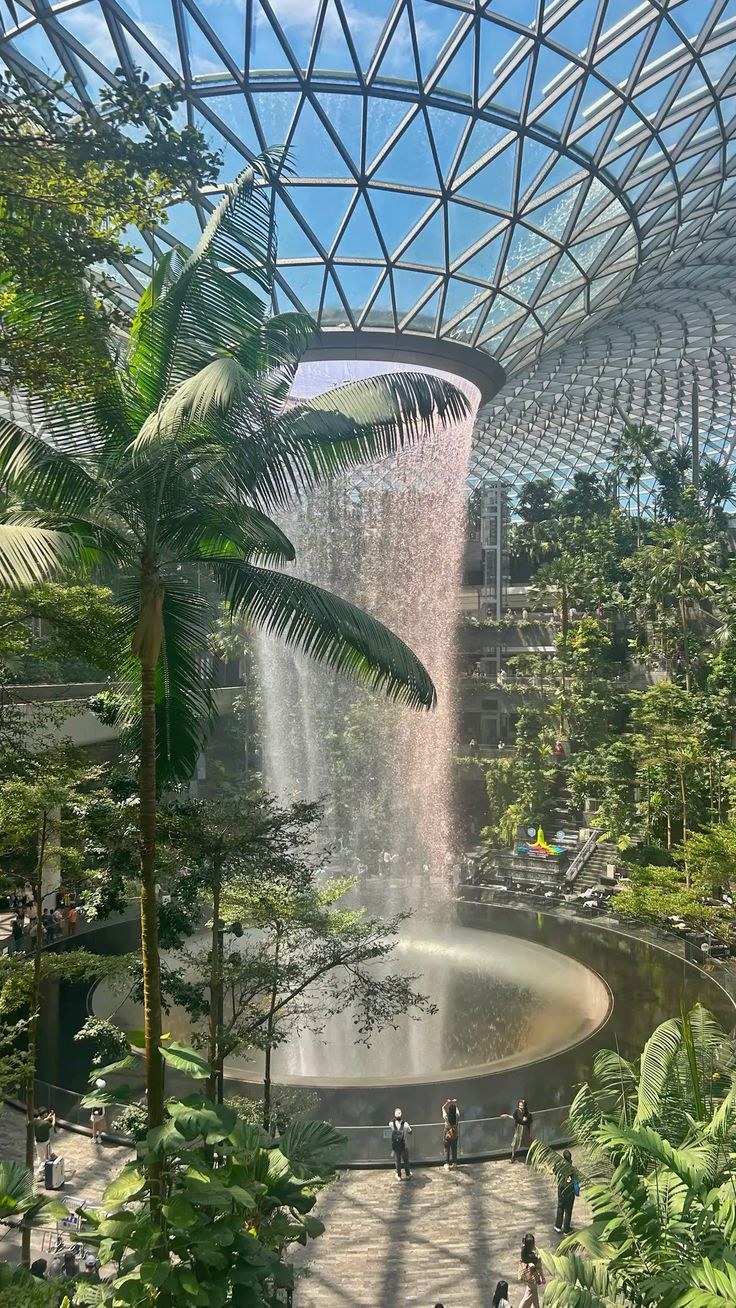
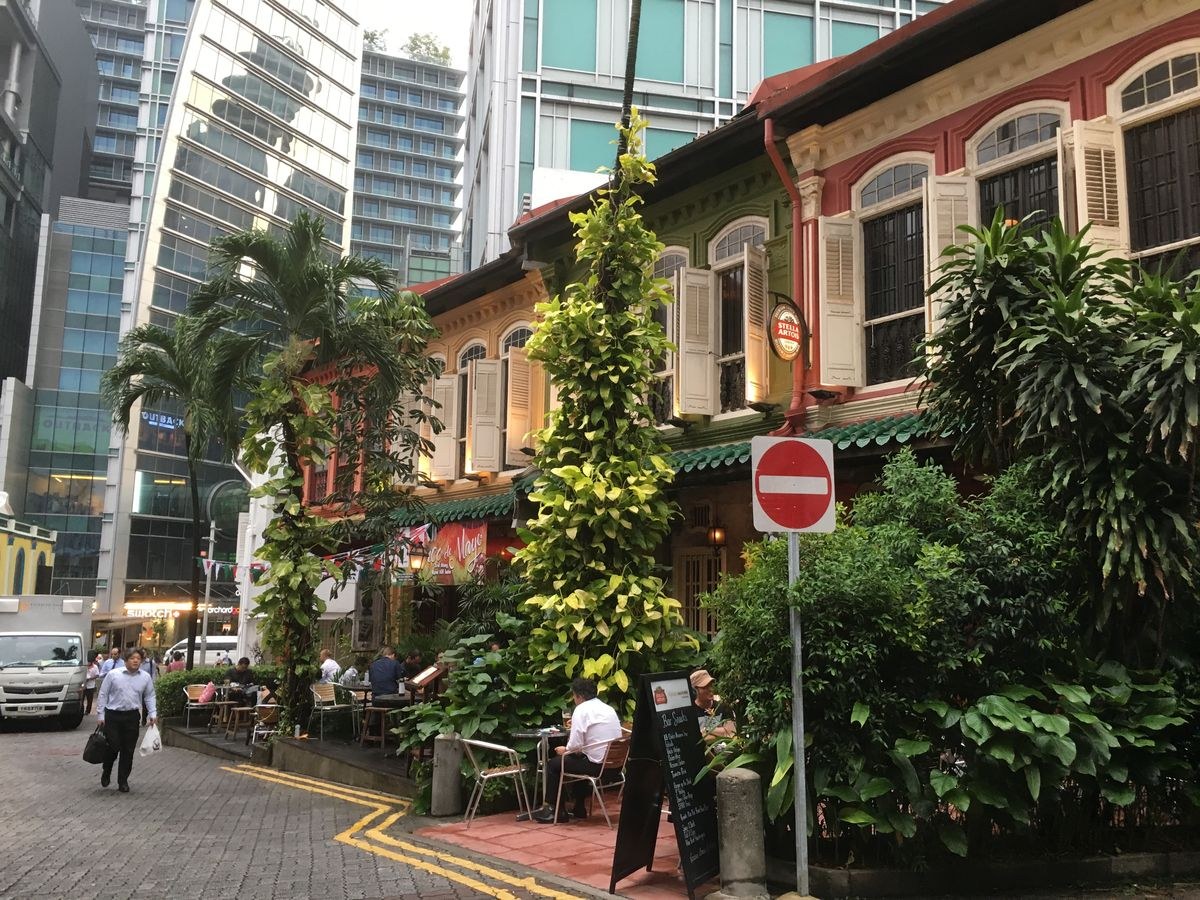
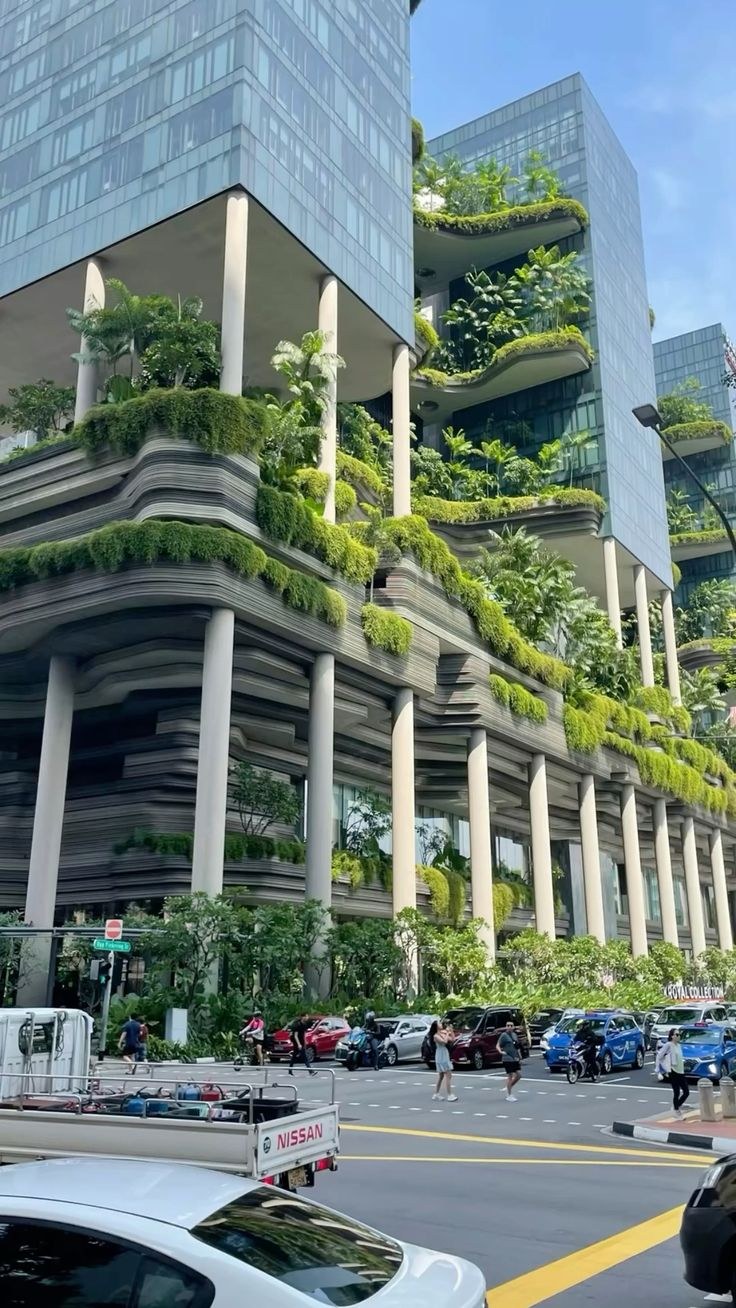
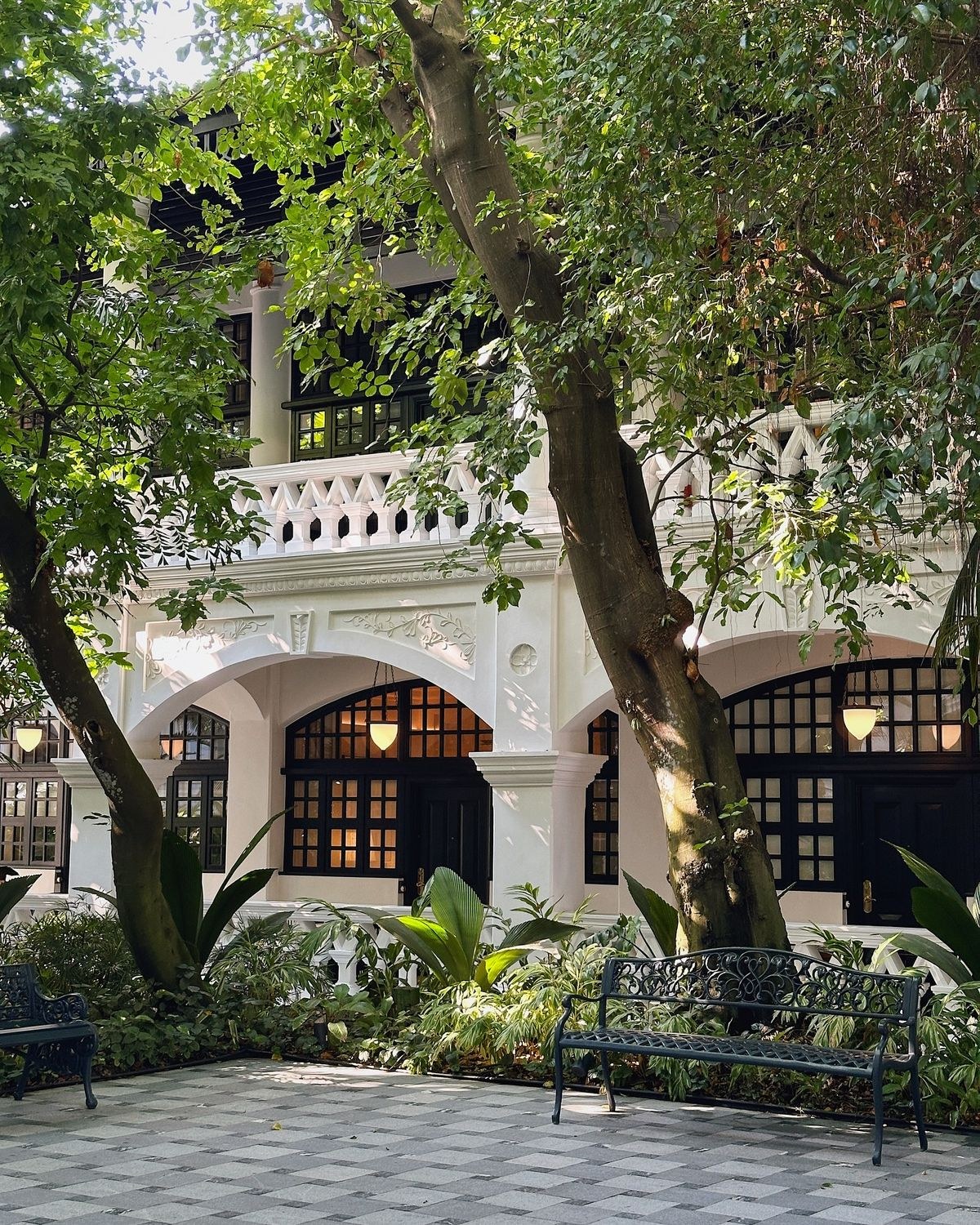
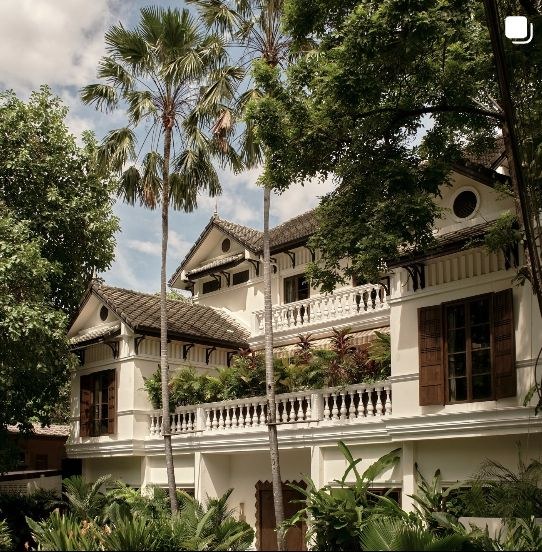
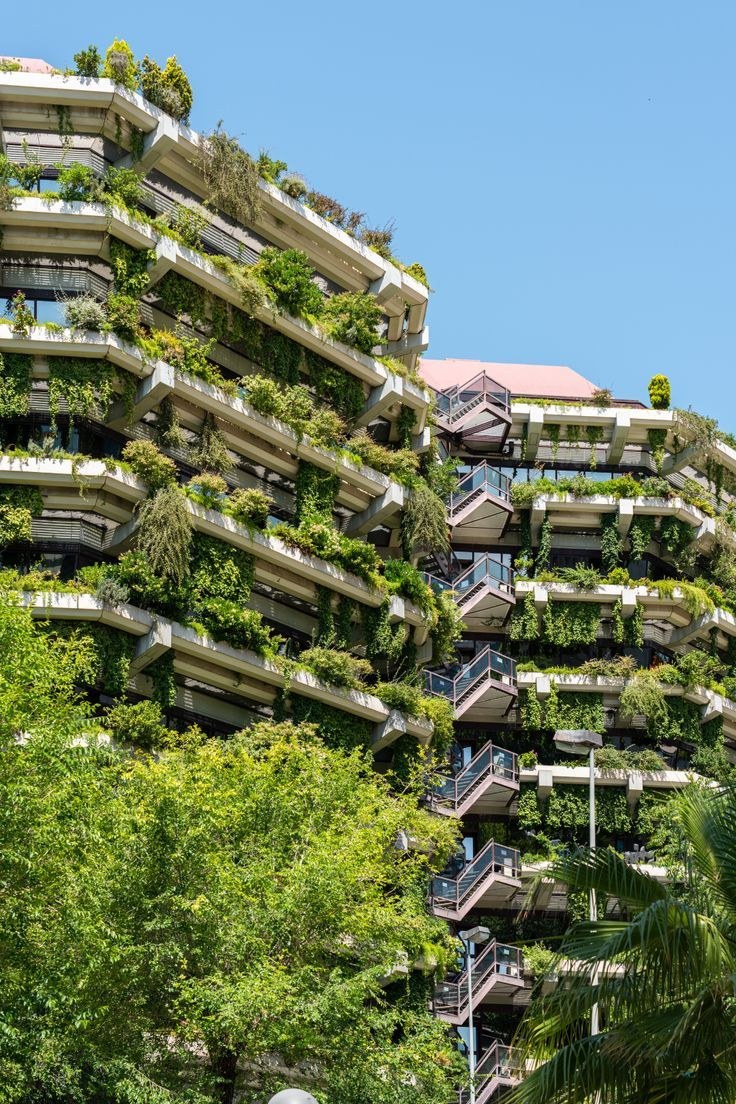
The images selected for this article reveal another side of Singapore's property identity: the city's obsession with the garden. Trees press against colonial facades. Tropical planting climbs across modern towers. Terraces become planted ledges. Glass atriums contain waterfalls. Older shophouses survive beneath newer corporate structures. The message is calm, lush and highly managed.
This green aesthetic is not separate from the economy. It helps justify density. It makes towers feel less harsh, malls feel less commercial, airports feel less transactional and residential projects feel more humane. In a city with limited land, greenery becomes a form of psychological space.
Jewel Changi is the most cinematic example. Enterprise Singapore describes it as a mixed-use development whose man-made waterfall in a lush terraced garden strengthens Changi Airport's position as a global air hub and stopover destination (Enterprise Singapore, n.d.). Architectural coverage has also described Jewel as a destination garden where landscape, retail and transport merge into one experience (Architectural Record, 2019).
This is Singapore's genius: it turns infrastructure into attraction. A terminal becomes a garden. A mall becomes a public interior. A financial district becomes a waterfront park. Real estate value is created not only through land and leases, but through atmosphere.
Private housing: expensive by design, fragile by politics
Singapore's private residential market exists under continuous political attention. URA's 4Q 2025 statistics showed private residential prices rising at a more modest pace of 0.6% quarter-on-quarter, after 0.9% growth in the previous quarter (Urban Redevelopment Authority, 2026). The government also sustained a robust supply pipeline through the Government Land Sales Programme to cater to demand and maintain market stability.
That phrase - maintain market stability - is crucial. Singapore does not treat housing purely as a private asset class. It is a social contract. If prices rise too quickly, affordability concerns deepen. If prices fall too sharply, household confidence and wealth can be affected. The state therefore acts as referee, supplier, planner and risk manager.
For private buyers, this creates both comfort and constraint. Singapore offers legal certainty, disciplined planning and long-term desirability. But it also offers cooling measures, stamp duties, credit rules and policy intervention. In other words, scarcity creates value, while the state decides how much of that value can safely be released.
Ageing, families and the next housing question
Singapore's demographic future adds another layer to the property story. Like many advanced Asian economies, Singapore is ageing. The Department of Statistics has shown a steady decline in the old-age support ratio over recent decades, meaning fewer working-age residents support each person aged 65 and over (Singapore Department of Statistics, 2025).
This changes the housing question. The next generation of real estate demand will not only be about bigger apartments, luxury condos or prime offices. It will also be about ageing in place, healthcare access, smaller households, intergenerational proximity, assisted living, accessible transport and neighbourhood services.
For a land-scarce country, ageing is not just a welfare issue. It is a spatial issue. More elderly households may need homes near clinics, transport and family. More young families may need affordable entry points. More single-person households may require smaller units. The state will have to keep redesigning scarcity around changing bodies, changing households and changing expectations.
Land reclamation and the future coastline
Singapore's scarcity story does not end at the current shoreline. URA's discussion of Long Island describes a potential reclamation project of about 800 hectares off the East Coast, intended to strengthen flood resilience, create a new reservoir and provide additional land for future development needs (Urban Redevelopment Authority, n.d.-b).
This is real estate as national engineering. In many countries, coastal land is inherited. In Singapore, it can be planned, raised, protected and created. But this also means the property market is tied to climate adaptation. Future land is not merely a growth opportunity; it is a defence strategy against sea-level rise.
The implication is profound. Singapore's next real estate cycle will not only be determined by interest rates, population growth or investor appetite. It will be shaped by water, heat, resilience and the cost of keeping a low-lying island liveable. In the long run, climate security may become one of the most important forms of property value.
The risk of a perfectly managed market
Singapore's strength is control. Its risk is also control. A tightly planned market can feel unusually stable, but it can also become expensive, exclusionary and dependent on policy precision. When land is scarce, mistakes are not easily absorbed. A poorly timed supply release, an overheated private market, a global recession, a shift in capital flows or a demographic mismatch can all have amplified consequences.
The city's success also creates expectations. Residents expect housing to remain accessible. Investors expect Singapore to remain safe. Companies expect offices to remain high quality. Tourists expect the city to be clean, green and spectacular. The state is therefore not merely managing land; it is managing belief.
That belief has enormous value. It is why global capital still arrives. It is why office rents can grow despite uncertainty. It is why luxury housing remains attractive despite regulation. It is why the city's architecture is so carefully staged: every planted terrace, restored shophouse and glass atrium reinforces the idea that Singapore knows what it is doing.
Conclusion: the country that turned scarcity into design
Singapore's real estate market is not simply expensive because land is scarce. It is expensive because scarcity has been organised into a system. Public housing anchors society. Government land sales discipline private supply. Reclamation creates new frontiers. Marina Bay turns made land into financial value. Jewel Changi turns infrastructure into spectacle. Green towers turn density into desire. The Master Plan turns national anxiety into urban order.
That is what makes Singapore different from many other global cities. Its property market is not just a reflection of wealth. It is a reflection of governance. The state has shaped where people live, how investors buy, where companies work, how the city expands and how scarcity is emotionally softened through greenery, water and design.
The challenge ahead is whether this model can keep balancing competing promises: affordability and asset values, public housing and luxury capital, heritage and redevelopment, density and nature, ageing and growth, climate risk and land creation.
Singapore has almost no room left to expand in the ordinary sense. But its entire modern history has been an attempt to expand the meaning of room itself. It has built land from sea, gardens inside airports, homes inside public policy and financial value out of disciplined scarcity. The island's real estate story is therefore not a story of shortage alone. It is the story of a country that turned limitation into architecture.
References
- Architectural Record. (2019). Moshe Safdie's Jewel Changi Airport in Singapore opens to the public. Architectural Record.
- CBRE. (2026a). 2026 Asia Pacific Investor Intentions Survey. CBRE Research.
- CBRE. (2026b, June 25). Singapore Grade A office market records sixth consecutive quarter of rental growth amid shifting global landscape. CBRE.
- CBRE Singapore. (2026). 2026 Singapore Real Estate Market Outlook. CBRE Research.
- Enterprise Singapore. (n.d.). Jewel Changi. Enterprise Singapore.
- Gov.sg. (2025). Evolution of public housing in Singapore. Government of Singapore.
- Singapore Department of Statistics. (2025). Population Trends 2025. Department of Statistics Singapore.
- Urban Redevelopment Authority. (2025). Master Plan 2025. URA.
- Urban Redevelopment Authority. (2026). Release of 4th Quarter 2025 real estate statistics. URA.
- Urban Redevelopment Authority. (n.d.-a). Marina Bay. URA.
- Urban Redevelopment Authority. (n.d.-b). Long Island. URA.
- Urban Redevelopment Authority. (n.d.-c). Optimising land. URA.
- House of Majlis | All rights reserved | Created 21 September 2026
© 2026 House of Majlis. All rights reserved.
Back to the archive