Riyadh: Oil, Stone and the New Arab Capital
How oil wealth, state planning and Vision 2030 transformed Riyadh from a Najdi oasis town into one of the world's most ambitious real estate markets.
How oil wealth, state planning and Vision 2030 transformed Riyadh from a Najdi oasis town into one of the world's most ambitious real estate markets.
The City That Turned Oil Into Urban Form
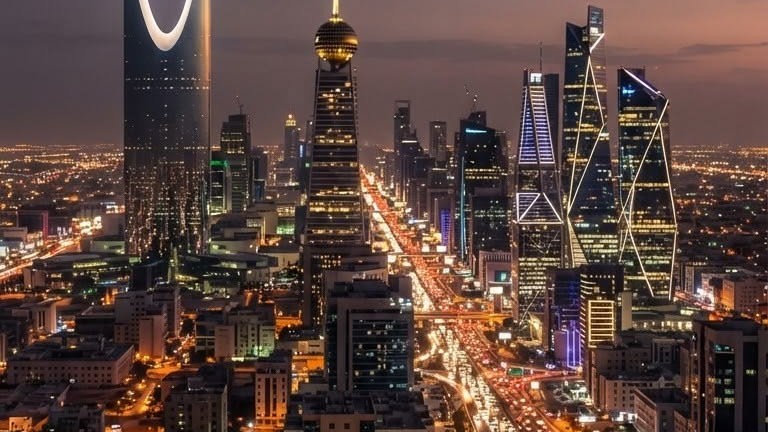
Riyadh is not a city that can be understood through skyline alone. Its towers are dramatic, but they are only the visible end of a much deeper transformation: a political capital, a desert settlement, a state-building project, an oil-financed metropolis, and now a global real estate experiment moving at extraordinary speed.
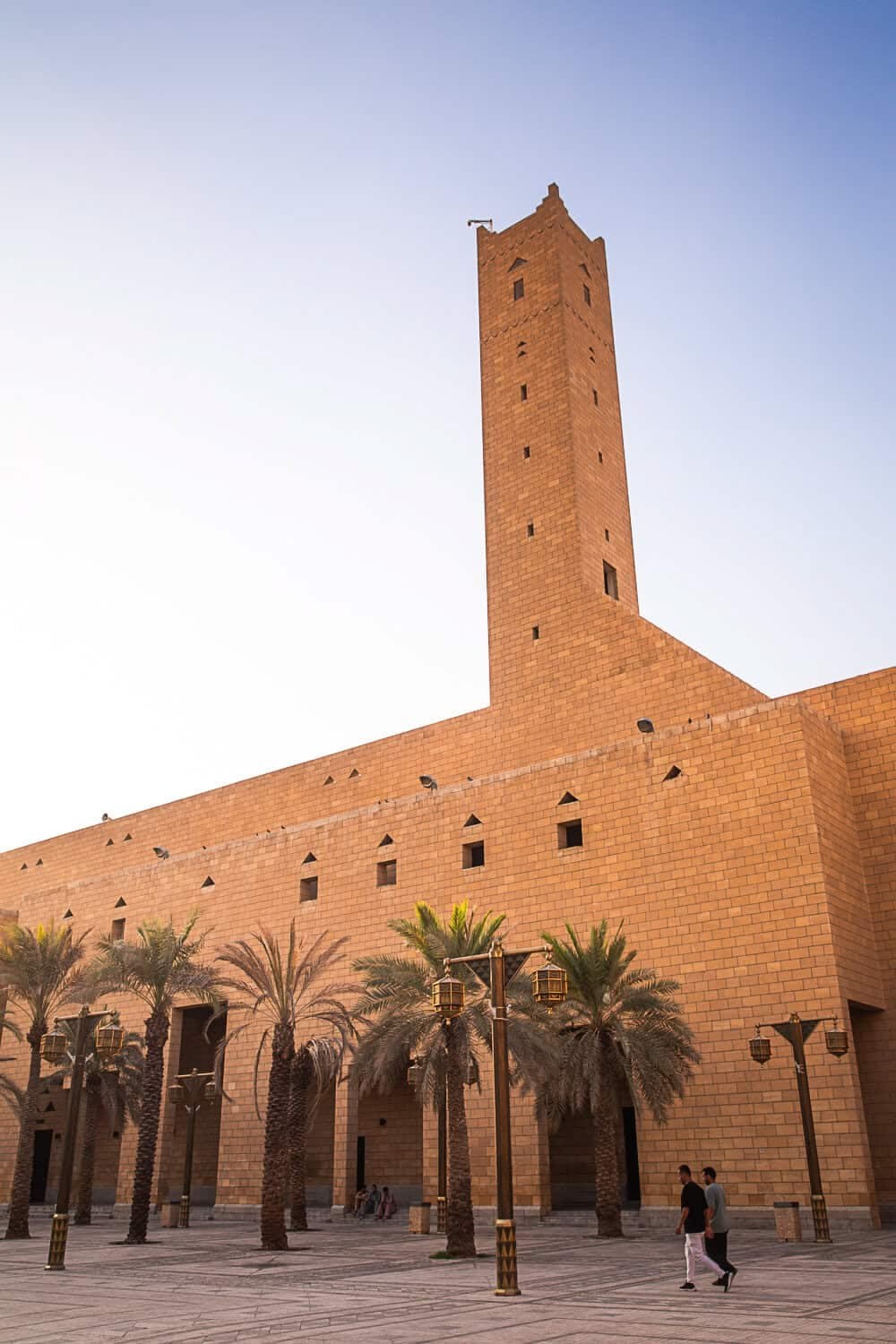
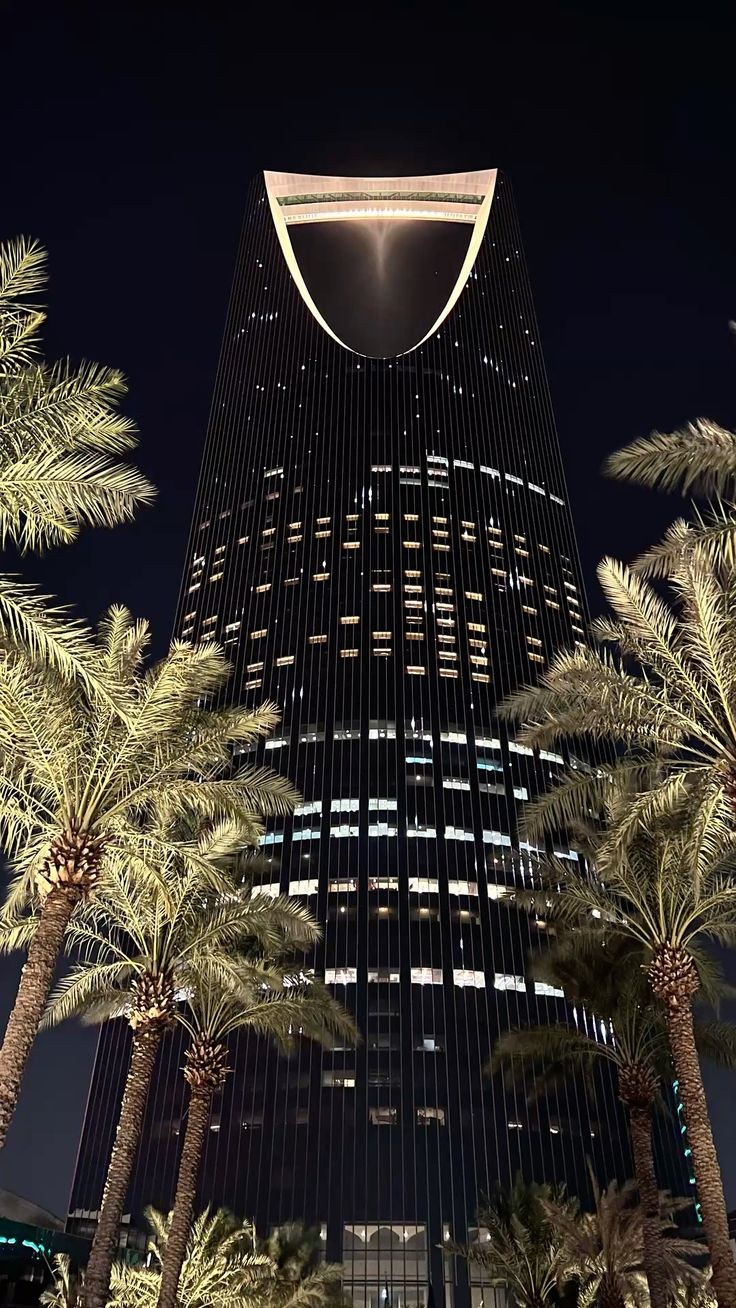
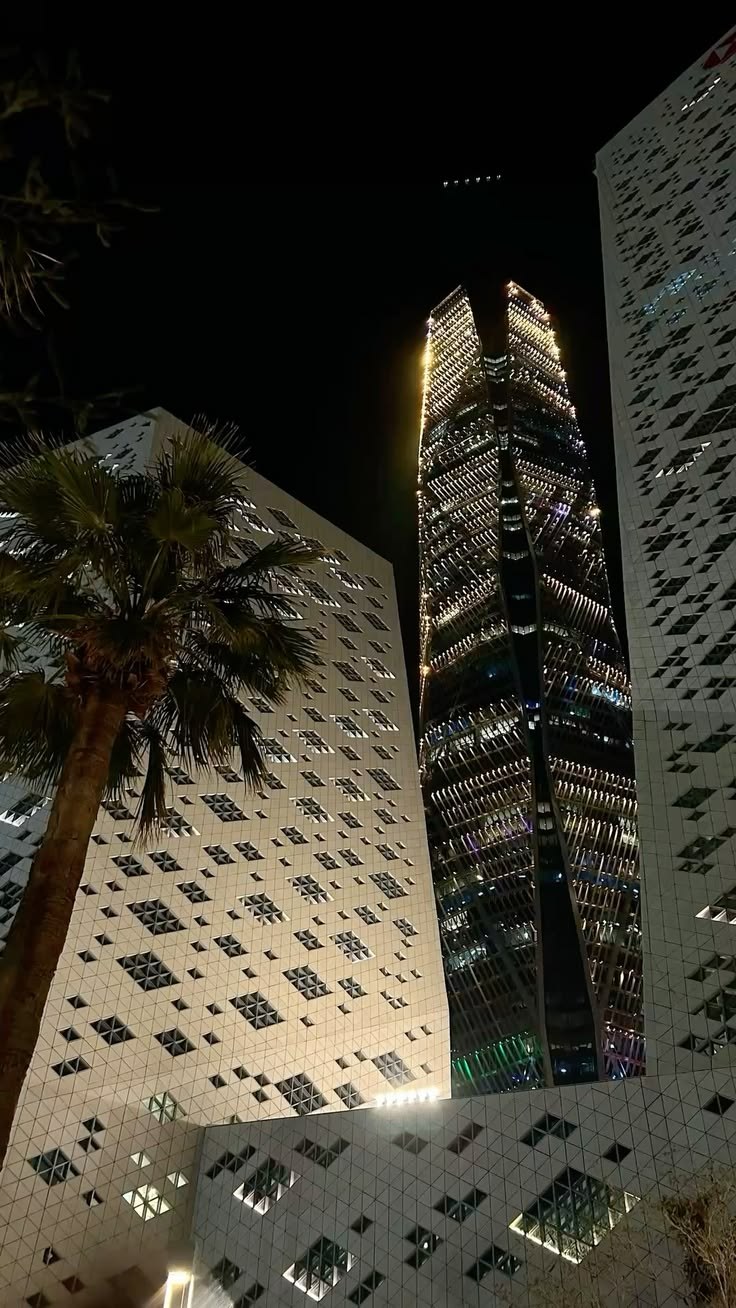
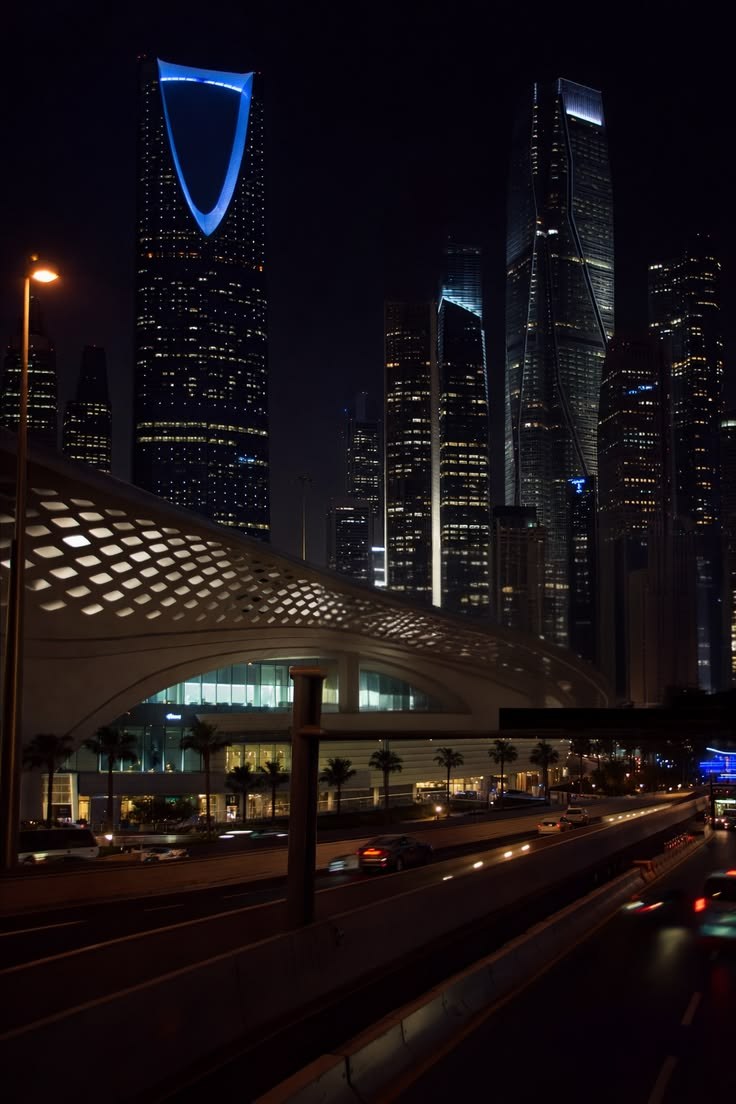
The images selected for this article capture that tension. The Kingdom Centre rises like a lit emblem in the night. The facades of KAFD fold and shimmer between white geometric surfaces and dark glass. A sand-colored mosque wall and palms recall an older architectural language, one rooted in heat, shade, prayer, courtyards and Najdi restraint. Riyadh's power comes from the way these worlds sit together.
This is not Madrid, where art, monarchy and historic urbanism slowly accumulated into prestige. Riyadh's real estate story is more abrupt, more state-driven and more closely tied to the economic history of oil. It is a city where national wealth became infrastructure, where infrastructure became land value, and where land value is now being reassembled into a Vision 2030 financial capital.
Riyadh is not simply growing. It is being recoded - from oil capital into global capital.
From Oasis Town to Capital of the Kingdom
The name Riyadh is often associated with gardens and cultivated spaces, and the city's official historical narrative connects it to older settlements in the Yamamah region, including Hajr, a historic center of trade and settlement in central Arabia (Riyadh Municipality, 2026). That origin matters. Before the highways, towers and business districts, Riyadh belonged to a landscape of wadis, wells, palm groves, mud-brick compounds, markets and mosques.
Its political importance deepened in the nineteenth and early twentieth centuries. Riyadh became the capital of the Second Saudi State in 1824 and was recaptured by Abdulaziz Ibn Saud in 1902, becoming the base from which the modern Saudi state was consolidated (Al-Hathloul, 2017). In that sense, Riyadh was never only a settlement. It was a seat of legitimacy.
This is why the city's real estate logic differs from many global capitals. Riyadh's land is not only urban land. It is political land. Its central districts, roads, ministries, mosques, royal institutions and later financial districts all reflect the role of the city as the physical stage of state authority. Property values have therefore been shaped not only by demand and supply, but by proximity to power.
Oil Wealth and the Structural Expansion of the City
The decisive rupture came with oil. Saudi Arabia's oil revenues did not merely enrich the state; they changed the structure of the built environment. Post-war revenues and the later oil boom gave the government the fiscal capacity to build roads, ministries, housing districts, utilities, airports and institutions at a scale that a traditional oasis city could never have financed organically (King Saud Library, 1959/2026; Riyadh Municipality, 2026).
By the 1970s, this transformation had become explosive. Research on Riyadh's development plans describes how the city moved through formal planning phases, including the Doxiadis master plan in the late 1960s and a major update during the mid-1970s oil boom (Al-Hathloul, 2017). In the same period, urban planning and land development were closely linked to public wages, state loans, land grants and elite investment. One academic account famously describes the Saudi elite as having invested oil money in real estate and literally turned oil into stone (Menoret, 2014).
That sentence captures the essence of Riyadh's real estate history. Oil did not only pay for buildings. It changed the economic meaning of land. Land became a storage mechanism for wealth, a tool of patronage, an investment asset, a symbol of status and a way to materialize national modernization.
The result was a city that spread outward with unusual speed. Riyadh moved from a compact town to a vast metropolitan territory, organized by wide roads, separated districts, government campuses, private villas and later commercial corridors. Unlike European cities, where density often grew from historic constraint, Riyadh's modern form grew from availability: land, oil revenue, road infrastructure and the political will to expand.
Oil did not only finance Riyadh's skyline. It changed the economic meaning of land itself.
The Arab City Beneath the Glass
And yet Riyadh is not simply a generic oil city. Its deeper identity is still Arab, and more specifically Najdi, in ways that matter for real estate. A true Arab city is not defined only by ornament or nostalgia. It is defined by relationships between public and private space, by the mosque and the market, by shade and threshold, by family life, hospitality, inward-facing domesticity and the management of climate through architecture.
Traditional Najdi architecture used thick walls, courtyards, small openings, shaded passages and textured surfaces as environmental and social devices. Modern Saudi architects and planners have repeatedly tried to reinterpret this language, especially in projects that seek to balance tradition and modernity. Scholarship on Riyadh's architectural identity argues that reinterpretations of traditional Najdi architecture can create continuity with historical context while adapting to modern techniques and urban scale (Saleh, 1998).
This is why Riyadh's most interesting real estate is not only the tallest or most expensive. It is the real estate that solves a cultural contradiction: how to create global offices, apartments, retail and hospitality without dissolving the city into anonymous international architecture. The palm, the wall, the courtyard, the mosque, the shaded edge and the sand-colored surface are not decorative details. They are part of Riyadh's attempt to remain legible as an Arab capital while becoming a global one.
KAFD and the Financialization of Riyadh
If the oil boom created the metropolitan base of Riyadh, Vision 2030 is attempting to reorganize that base into a global economic platform. Nowhere is that more visible than in King Abdullah Financial District. KAFD is owned and managed by a Public Investment Fund subsidiary and is described as a business and lifestyle destination with state-of-the-art physical and digital infrastructure (Public Investment Fund, n.d.).
KAFD's own materials describe the district as a first vertical city spanning 1.6 million square meters, with 95 buildings designed by 25 international architectural firms, and as the world's largest LEED Platinum-certified business and lifestyle district (KAFD, n.d.). This is real estate as national strategy. The district is not just meant to provide offices. It is meant to reposition Riyadh in the geography of finance, talent, corporate headquarters and international capital.
The Regional Headquarters program has accelerated this shift. CBRE reported that Riyadh's office market faced structural scarcity of Grade A space in Q1 2026, with 98% occupancy and more than 780 international firms under the RHQ program (CBRE, 2026a). In Q4 2025, CBRE recorded 99% Grade A office occupancy in Riyadh and highlighted competition for future supply (CBRE, 2025). JLL similarly observed that new office inventory is gradually moderating rental growth, but that the capital remains a highly competitive office market (JLL, 2026).
This pressure is important. It shows that Riyadh's property market is no longer merely residential or domestic. It is being pulled by corporate migration, state incentives and a national desire to make the capital the command center of the non-oil economy.
The Majlis Newsletter
Continue reading with us. New essays on markets, pipelines and capital, delivered as they publish.
Residential Real Estate: Demand, Affordability and the New Middle Class
Riyadh's residential market tells a different, more complicated story. The city remains the focal point of Saudi Arabia's housing activity. Knight Frank reported that Riyadh is central to the Kingdom's residential market, supported by population growth, investment and policy reform, while also noting that 346,700 units are planned or due to complete between 2026 and 2028 (Knight Frank, 2026a).
The scale is remarkable, but so are the risks. Saudi Arabia has pursued ambitious home ownership goals, and state-backed housing development has become a central part of the real estate ecosystem. At the same time, high prices can suppress demand. Knight Frank noted a sharp slowdown in Saudi residential activity in Q1 2026, with transaction volumes down 50% year-on-year and transaction values down 57%, while office fundamentals in Riyadh remained stronger (Knight Frank, 2026b).
This creates a two-speed city. On one side, Riyadh's corporate and government-backed real estate engine is creating premium districts, business demand and international visibility. On the other, ordinary housing must remain accessible to Saudi households if the city is to function as more than a showcase. A capital cannot live only through towers and headquarters. It also needs schools, apartments, family villas, rents that make sense and neighborhoods that can absorb a growing workforce.
CBRE described this as a residential "precision gap": long-term absorption depends on how closely new products match the needs of a mobile, rental-oriented workforce (CBRE, 2026a). That phrase is useful because it cuts through the spectacle. Riyadh does not simply need more real estate. It needs the right real estate.
The Skyline as Economic Policy
The night images of Riyadh's skyline are seductive because they compress a century of transformation into a single view. Kingdom Centre, Al Faisaliah, KAFD and the illuminated arteries of King Fahd Road all communicate one message: Riyadh has entered the visual language of global capital.
But unlike Dubai, whose real estate brand has often been built through lifestyle spectacle and international investor glamour, Riyadh's current boom is more tied to state-directed economic restructuring. Vision 2030 is not only a tourism or branding exercise. It is a reallocation of national ambition from oil dependency toward finance, logistics, entertainment, sports, culture, technology, hospitality and urban quality of life.
Real estate is the physical platform for that transformation. Offices house the incoming corporations. Residential districts house the workforce. Retail and hospitality districts support the new consumption economy. Heritage areas and public realm projects give the city cultural depth. Transport infrastructure is meant to make scale manageable. In Riyadh, property is not a side effect of economic policy. It is one of its main instruments.
The Risk of Building Faster Than the City Can Absorb
The strongest argument for Riyadh is also the source of its risk: scale. The city is growing under a national program that has political backing, sovereign capital, population ambition and international corporate momentum. Few cities in the world have that combination.
But scale does not remove market discipline. It increases the cost of getting the product wrong. If office supply arrives before demand matures, rent growth can soften. If residential stock is too expensive, too remote or poorly aligned with household needs, absorption slows. If luxury and symbolic projects dominate at the expense of everyday urbanity, Riyadh risks becoming impressive before it becomes fully livable.
This is not a prediction of failure. Riyadh's fundamentals are real. The city has political importance, public investment, corporate relocation, demographic growth and a national development strategy behind it. But a real estate market can be strategically important and still contain pockets of overpricing, mismatch and speculative optimism.
Riyadh does not simply need more real estate. It needs the right real estate.
Conclusion: A Capital Built Between Desert Memory and Financial Ambition
Riyadh's real estate story is ultimately the story of Saudi Arabia itself. A desert settlement became a political capital. A political capital was transformed by oil. Oil wealth built roads, ministries, villas, infrastructure and land markets. The 1970s turned state revenue into urban expansion. Vision 2030 is now trying to turn that urban expansion into a global platform for finance, lifestyle and non-oil growth.
The city's future will depend on whether it can hold these layers together. It must remain Arab without becoming nostalgic. It must become global without becoming generic. It must build quickly without losing coherence. It must attract international capital while serving Saudi households. It must transform oil wealth into sustainable urban value rather than only into more stone, glass and illuminated towers.
The photographs in this article reveal the tension beautifully: the palm and the tower, the mosque and the skyline, the desert wall and the financial district. Riyadh is at its most powerful when these are not contradictions but continuities.
Perhaps that is the city's real definition. Riyadh is not trying to become another Dubai, London or New York. At its best, it is trying to become something more difficult: a true Arab capital of the twenty-first century, built from desert memory, oil wealth, state ambition and a new economic imagination.
Editorial Note
This article is part of the House of Majlis editorial series on cities, real estate and the visual economy of place. It has been written and designed as an editorial long-read, combining market research with architectural interpretation.
References
- Al-Hathloul, S. (2017). Riyadh development plans in the past fifty years (1967-2016). Current Urban Studies, 5, 97-120.
- CBRE. (2025). Saudi Arabia real estate market review Q4 2025. CBRE Saudi Arabia.
- CBRE. (2026a). Saudi Arabia real estate market review Q1 2026. CBRE Saudi Arabia.
- CBRE. (2026b). Saudi Arabia's non-oil economy powers next phase of real estate growth. CBRE Saudi Arabia.
- JLL. (2026). Kingdom of Saudi Arabia office market dynamics, Q2 2026. JLL Research.
- KAFD. (n.d.). FAQ page - Your questions answered. King Abdullah Financial District.
- King Saud Library. (1959/2026). Riyadh: Between past and present. The King Saud Library.
- Knight Frank. (2025). Emerging wealth hub series: Riyadh. Knight Frank Saudi Arabia.
- Knight Frank. (2026a). Destination Saudi 2026: The story behind the numbers. Knight Frank Saudi Arabia.
- Knight Frank. (2026b). Saudi Arabia residential and office sector. Knight Frank Saudi Arabia.
- Menoret, P. (2014). Real estate and political power in 1970s Riyadh. City, 18(6), 658-673.
- Public Investment Fund. (n.d.). King Abdullah Financial District. Public Investment Fund.
- Riyadh Municipality. (2026). About Al-Riyadh. Al Riyadh Municipality.
- Saleh, M. A. E. (1998). The integration of tradition and modernity: A search for an urban and architectural identity in Arriyadh, the capital of Saudi Arabia. Habitat International, 22(4), 571-589.
© 2026 House of Majlis. All rights reserved.
Back to the archive