Madrid: Capital in Stone
How art, history and scarcity shape the economics of real estate.
The City That Prices Memory
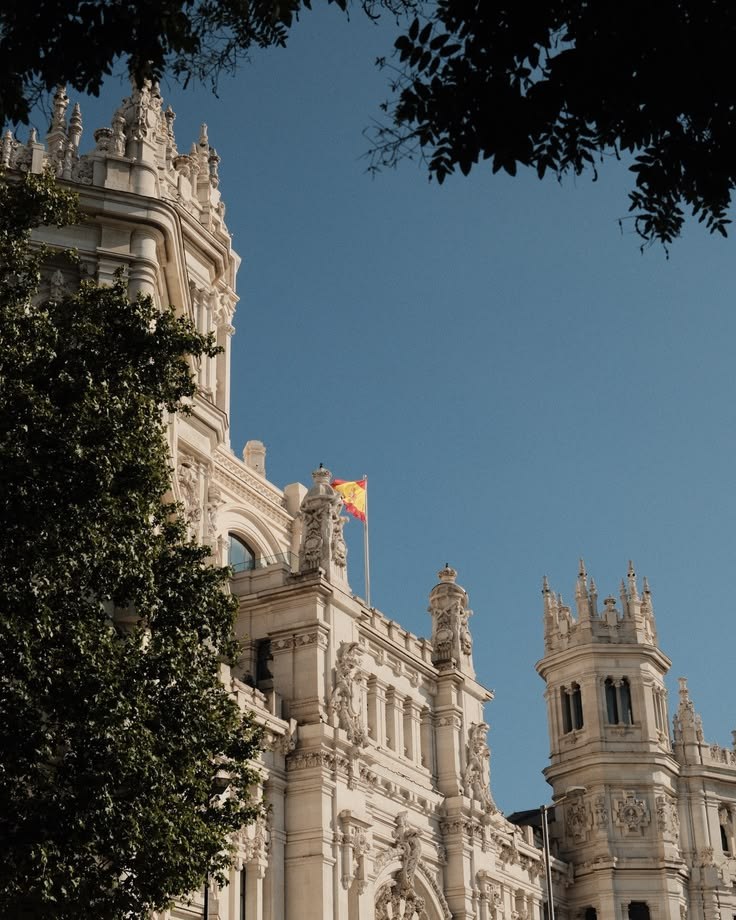
Madrid does not announce itself with the instant spectacle of a new skyline. It is a capital that works more slowly on the imagination: stone façades warmed by afternoon light, iron balconies, palace cornices, shaded avenues, museum walls, old cafés, small streets opening suddenly into monumental squares.
That slowness is part of its value. In Madrid, real estate is not shaped only by yield, interest rates and supply. It is shaped by memory. Buyers are not merely purchasing floor area. They are buying proximity to a civic idea: art, monarchy, state power, cafés, theatre, parks, galleries and the confidence of a European capital that has learned to convert history into economic gravity.
This makes Madrid one of the most interesting residential markets in Europe. It is not the loudest. It is not the most aggressively futuristic. But its strength lies in the way culture and capital overlap. In the best districts, an apartment is never just an apartment. It is an address inside a historical narrative.
A Market Held Up by Demand, Scarcity and Confidence
The numbers explain why Madrid is increasingly difficult to ignore. Idealista's price data placed the city of Madrid at EUR 6,471 per square metre in August 2026, with year-on-year growth of 10.2%. Across the wider Community of Madrid, the figure stood at EUR 5,059 per square metre, still up 7.0% year on year (Idealista, 2026a; Idealista, 2026b).
Those figures reflect more than a cyclical rebound. Madrid benefits from a combination of domestic demand, international relocation, institutional investment and limited central supply. The Banco de España has warned that Spain faces a structural housing imbalance, with household creation outpacing construction, and with affordability pressure especially visible in large urban markets such as Madrid (Banco de España, 2026).
In prime neighbourhoods, the pressure is even more concentrated. Knight Frank describes Madrid as a market with limited supply, growing demand and a stronger global profile among wealthy buyers. Its 2025/26 Madrid Insight report highlights the city's rising status within the European luxury real estate landscape, including the emergence of prestigious launches and branded residences (Knight Frank, 2026).
CBRE makes a similar point from the luxury side. Its report on Madrid's prime residential market argues that the city's most exclusive areas have seen sustained price growth while still remaining relatively competitive compared with ultra-prime European markets such as London, Paris and Milan (CBRE Spain, 2026a). Madrid is expensive by Spanish standards, but still feels comparatively rational to certain global buyers. That gap is part of the investment story.
The Historic Centre as Financial Infrastructure
Madrid's real estate economy cannot be understood without its historic centre. The city's heritage is not decorative background. It functions as infrastructure: it organises movement, prestige, tourism, institutional life and investment demand.
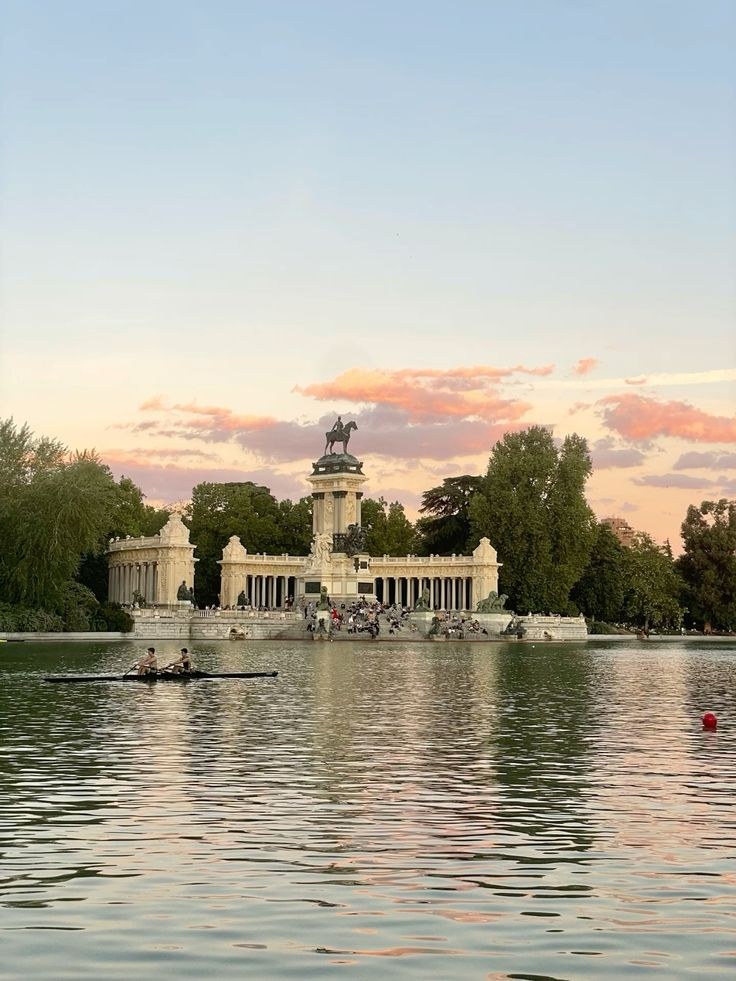
The Paseo del Prado and Buen Retiro were inscribed by UNESCO as a cultural landscape of Arts and Sciences. UNESCO describes the area as a designed urban landscape that combines culture and nature and has evolved over centuries in the heart of Madrid (UNESCO World Heritage Centre, 2021). The Spanish Ministry of Culture links the area to the enlightened urban project of Charles III, which brought together scientific, cultural and civic institutions such as the Royal Botanical Garden, the Observatory and the Prado Museum (Ministerio de Cultura, n.d.).
This matters for property because cultural density creates durable demand. Around the Prado-Retiro axis, art, science, institutions, public gardens, luxury hotels, embassies, ministries and historic architecture form an urban environment that cannot easily be copied. Supply is naturally constrained, while symbolic value is continuously renewed.
The result is a form of real estate value that is cultural before it becomes financial. Buyers may speak the language of price per square metre, but what they are often buying is nearness: near Retiro, near the Prado, near Cibeles, near Salamanca, near the streets where Madrid still feels most like itself.
Art, Architecture and the Price of Belonging
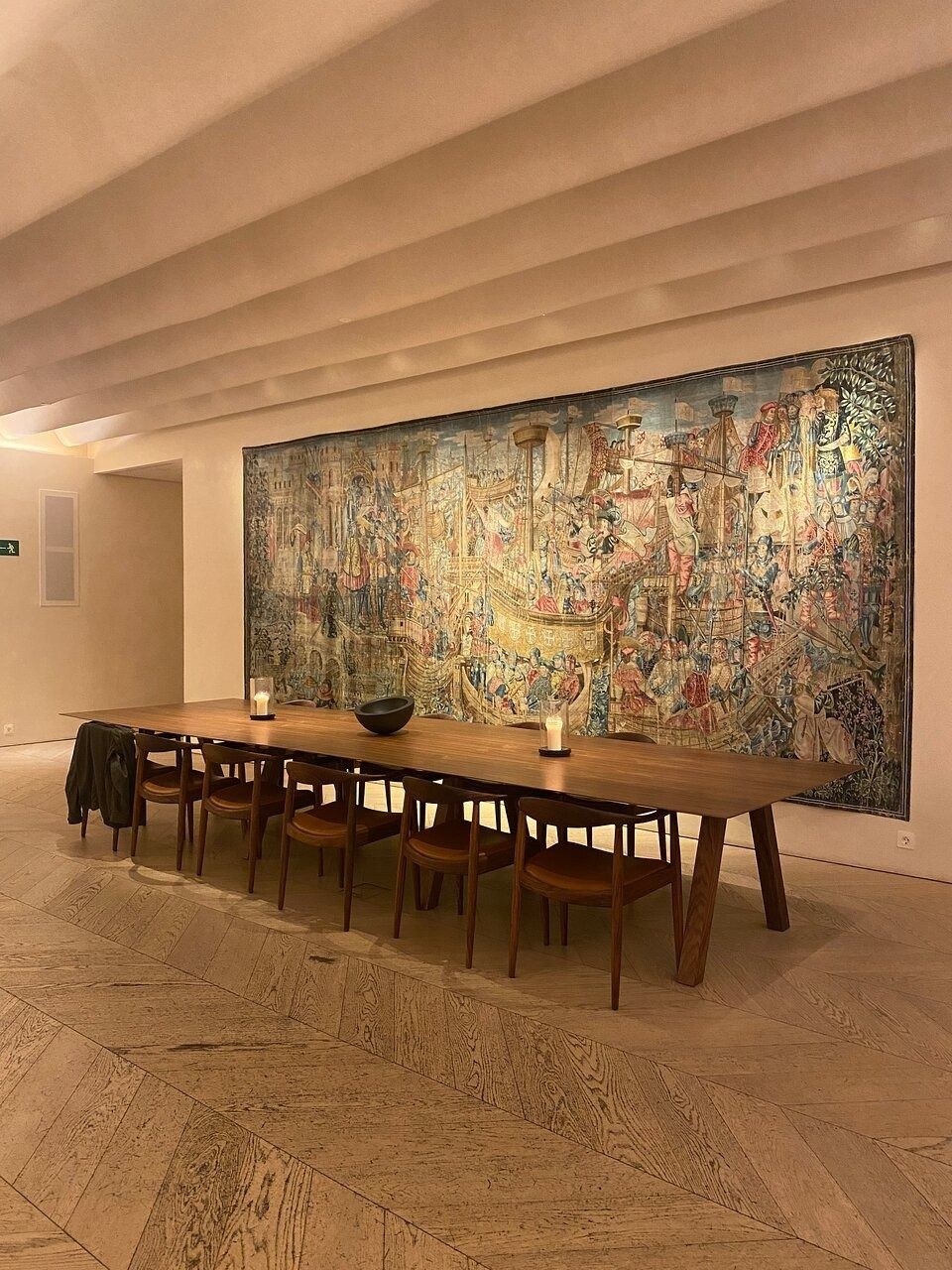
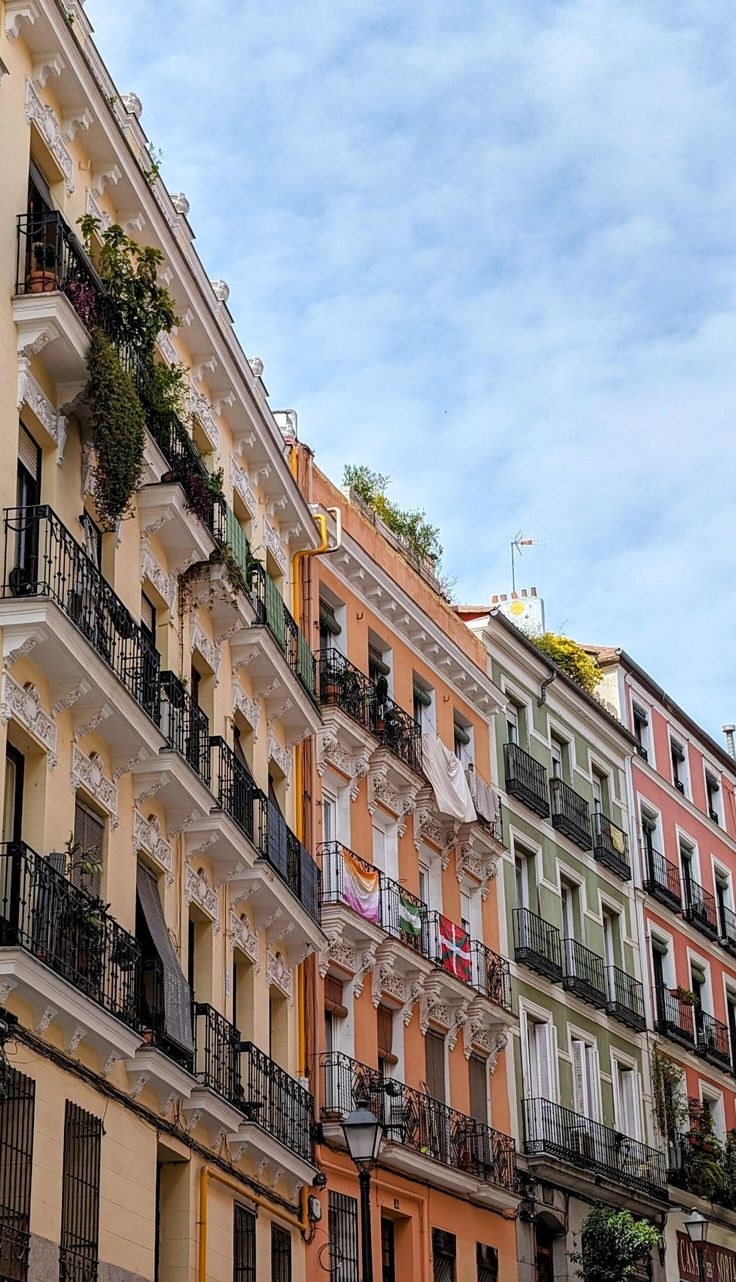
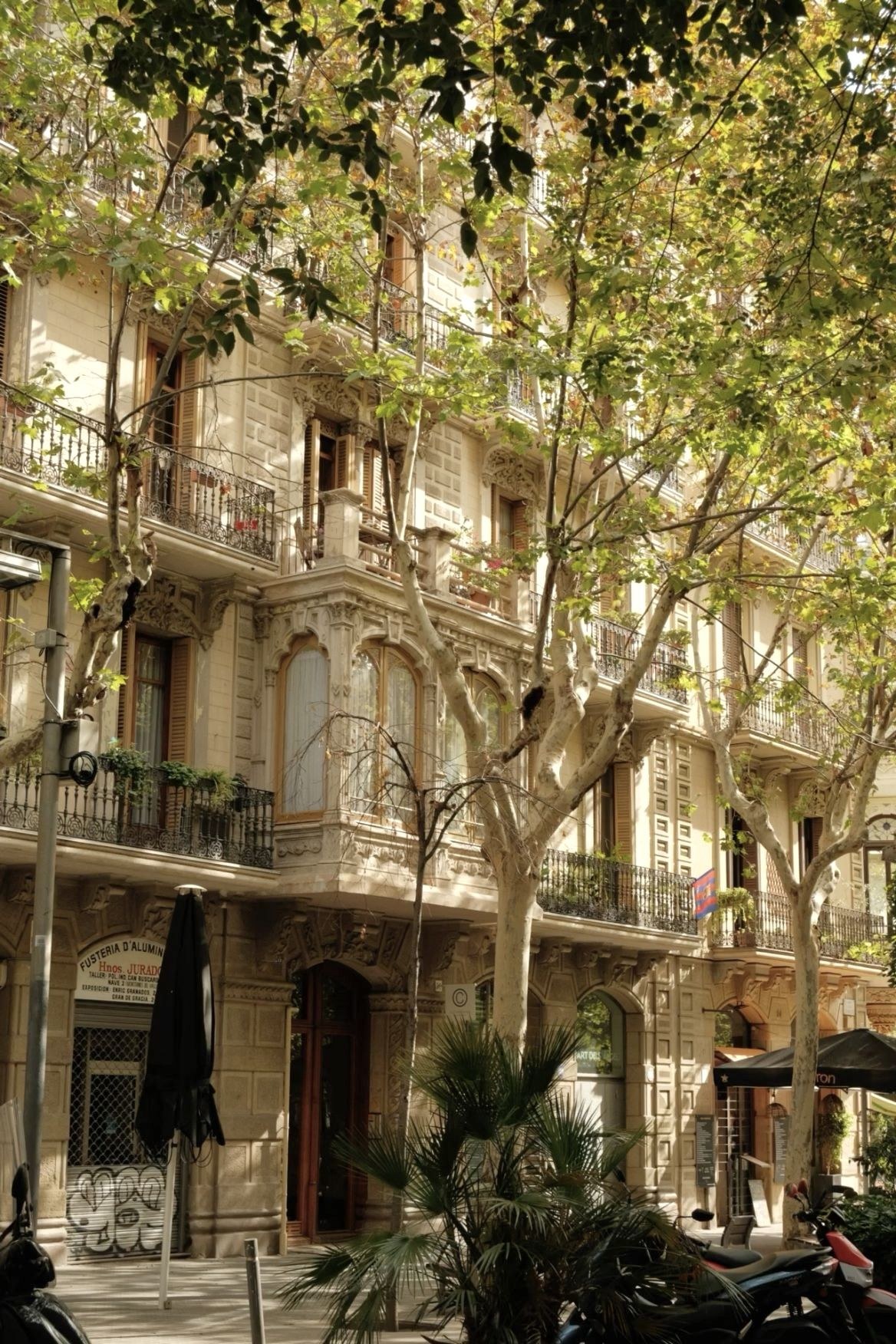
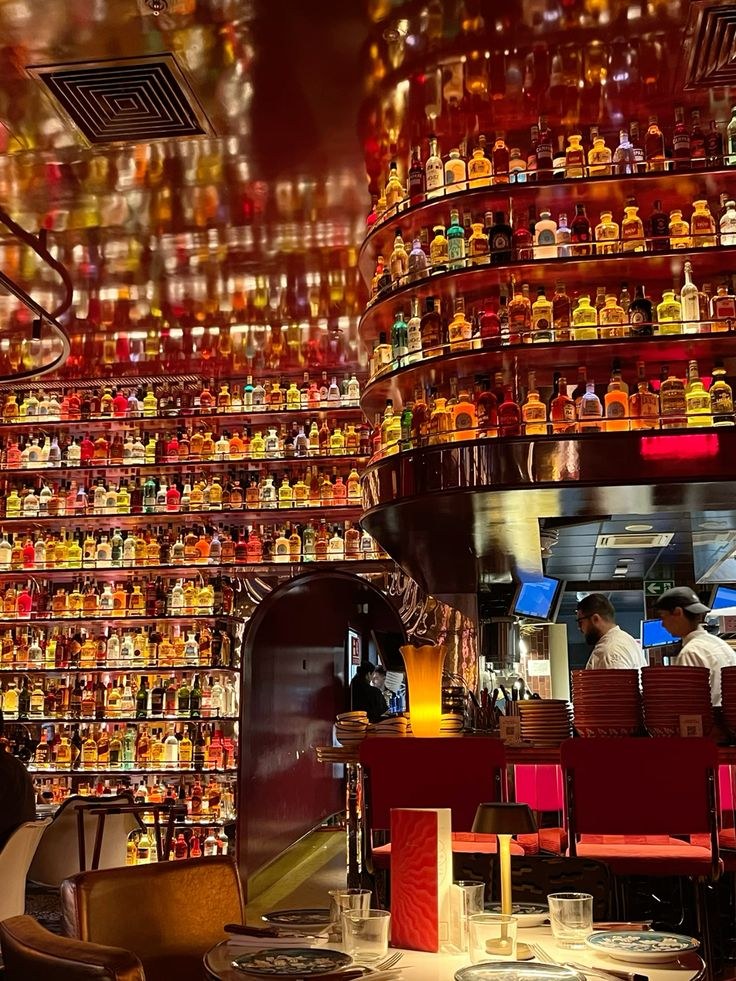
The images in this article point to the emotional economics of Madrid. A grand institutional façade beneath the Spanish flag. A dining room dominated by a tapestry-like artwork. Rows of pastel façades and wrought-iron balconies. Retiro at sunset. A leafy street where architecture and shade soften the density of the city. A bar glowing with amber light and bottles, more theatre than hospitality.
Together they show why Madrid's real estate is not only a product of the housing market. It is a product of atmosphere. The city's most desirable neighbourhoods convert art, texture and history into value. A balcony is not simply outside space; it is participation in a street scene. A restored façade is not simply heritage; it is scarcity. A nearby museum is not simply culture; it is a signal of permanence.
This is especially important for international buyers. In a global market where many luxury apartments look increasingly similar, Madrid's appeal is specificity. The city offers something that cannot be fully replicated in a branded tower: the feeling of living inside a layered European capital, where the art collection, the palace, the boulevard, the café and the apartment all speak the same language of continuity.
That is why Madrid's older neighbourhoods behave differently from purely speculative districts. They are not immune to correction, but their value is less dependent on a single development cycle. Heritage creates an emotional floor beneath the market.
The Majlis Newsletter
Continue reading with us. New essays on markets, pipelines and capital, delivered as they publish.
Luxury Without the Need to Shout
Madrid's luxury is often quieter than the glamour of coastal or resort markets. It is found in scale, stone, walkability, old-world interiors, museum proximity, private clubs, refined hospitality and a dining scene that treats tradition and modernity as compatible forces.
This quietness is commercially powerful. Prime buyers increasingly seek cities that offer lifestyle quality as much as pure financial performance. Savills has noted that Iberian prime markets, including Madrid, were expected to see strong capital value appreciation in 2025, supported by lifestyle demand, buyer mobility and relative value compared with more established global cities (Savills, 2025).
Madrid's advantage is that it can appeal to several buyer profiles at once. It attracts Spanish families seeking security, Latin American capital seeking a European base, executives relocating for work, students and parents drawn by education, and international buyers who want culture without the scale or cost of Paris or London.
The result is a layered demand base. That is healthier than a market dependent on one type of buyer. But it also creates tension. When many groups compete for the same central neighbourhoods, price growth becomes less about luxury alone and more about access to urban life.
The Office Spine: Castellana, Cibeles and the Business of Prestige
Madrid's property market is not only residential. Its financial geography has long been tied to a north-south institutional and office spine: Cibeles, Recoletos, Castellana, the business districts and the emerging northern extension of the city.
JLL reported that the Madrid and Barcelona office markets closed 2025 as the third-best year since 2020, with more than 856,000 square metres leased across both cities. Madrid performed above the average of the previous decade, reflecting a solid occupier market and continued demand for quality space (JLL, 2026).
CBRE's Q4 2025 figures also described Madrid's office market as active, with 486,000 square metres transacted, while its broader valuation work pointed to the recovery of prime offices in Madrid and Barcelona and the renewed importance of sustainable, high-quality buildings (CBRE Spain, 2026b; CBRE Spain, 2025).
This matters for residential real estate because economic prestige tends to travel. Office demand supports executive relocation, rental pressure, hospitality, retail and neighbourhood upgrades. In Madrid, the line between cultural prestige and financial prestige is unusually visible: the museum axis, the old state institutions and the modern business corridor are not separate cities. They are connected by avenues, parks, hotels and addresses.
Madrid Nuevo Norte and the Future of the Capital
If the historic centre explains Madrid's inherited value, Madrid Nuevo Norte explains its future pricing logic. The project around Chamartín is not only a development scheme. It is a statement about how the capital wants to grow: denser, better connected, more international and more oriented toward mixed-use urban life.
Crea Madrid Nuevo Norte describes the project as having a significant economic impact, while the Madrid City Council has reported progress on the planning area where 7,138 homes are expected, including more than 1,400 protected homes (Crea Madrid Nuevo Norte, n.d.; Ayuntamiento de Madrid, 2025). The project also sits around a crucial transport node, giving it strategic importance beyond ordinary residential supply.
For investors, the question is not only whether Madrid Nuevo Norte will add homes and offices. It is whether it will create a new premium geography. If it succeeds, Madrid's economic centre of gravity may stretch further north, linking Chamartín more tightly to Castellana and the broader business market.
That expansion could ease pressure in some areas, but it could also intensify the city's segmentation: a historic core priced by scarcity and culture, a northern business axis priced by corporate growth, and peripheral districts where affordability becomes the defining social question.
The Risks Behind the Beauty
Madrid's appeal is real. But real appeal can still create real pressure.
The first risk is affordability. If prices continue to rise faster than local incomes, the city risks becoming less accessible to the very residents who give it cultural depth. A capital can attract foreign capital and still lose social balance. That is the uncomfortable paradox of successful urban markets.
The second risk is conservation without enough supply. Madrid's historic fabric is a strength, but it also limits development in the central areas buyers most desire. Preservation protects value, yet it can also push demand into fewer available assets, lifting prices and encouraging conversion to higher-end uses.
The third risk is that lifestyle demand becomes too dominant. Culture, restaurants, museums and historic streets are not problems. They are the soul of the city. But when the city is packaged too aggressively as a lifestyle asset, homes can drift away from their ordinary purpose and become stores of capital, temporary residences or branded experiences.
That is where Madrid must be careful. Its charm lies in authenticity. If every street becomes an investment narrative, the very quality that made it valuable can begin to erode.
Conclusion: Heritage as Value, Scarcity as Risk
Madrid's real estate market is powerful because it rests on more than construction. It rests on accumulated meaning. Its art, history, architecture and civic institutions do not simply decorate the market; they help price it.
The Prado-Retiro landscape, the institutional façades around Cibeles, the streets of Salamanca and Chamberí, the cultural confidence of the museums, the economic pull of Castellana and the future ambition of Madrid Nuevo Norte all form part of the same story. Madrid has become a city where heritage and capital reinforce one another.
That makes the market resilient, but not risk-free. The same scarcity that protects value can worsen affordability. The same cultural prestige that attracts buyers can accelerate gentrification. The same financial confidence that supports investment can push prices beyond the reach of local demand.
Madrid is not a city built on a mirage. Its value is deeply rooted. But rooted markets can still become tense markets. The lesson is not that Madrid's real estate is overhyped, nor that it is immune to correction. The lesson is that Madrid must be read differently: not as a city where property merely follows economics, but as a city where art, history, institutions and finance have become inseparable.
In Madrid, stone remembers. The market listens. And the price of belonging continues to rise.
References
- Ayuntamiento de Madrid. (2025, May 27). El Pleno desbloquea la zona donde más viviendas se construirán en Madrid Nuevo Norte: 7.138 casas, de las que más de 1.400 serán protegidas. https://www.madrid.es/
- Banco de España. (2026). Annual Report 2025: Housing and real estate market. Banco de España. https://www.bde.es/
- CBRE Spain. (2025). Valoraciones inmobiliarias 2025: El mercado español acelera y redefine sus prioridades. https://www.cbre.es/
- CBRE Spain. (2026a). Madrid brilla en el lujo residencial europeo. https://www.cbre.es/
- CBRE Spain. (2026b). Índice CBRE Q4 2025: Evolución de los mercados inmobiliarios en España. https://www.cbre.es/
- CBRE Spain. (2026c). Living, market data: Figures fourth quarter 2025 Spain. https://www.cbre.es/
- Crea Madrid Nuevo Norte. (n.d.). Know all the economic and social impact of the project. https://creamadridnuevonorte.com/
- Idealista. (2026a). Evolución del precio de la vivienda en venta en Madrid. Idealista/Data. https://www.idealista.com/
- Idealista. (2026b). Informe de precios en venta en Madrid Comunidad. Idealista/Data. https://www.idealista.com/
- JLL. (2026, January 27). El mercado de oficinas en Madrid y Barcelona cierra 2025 como el tercer mejor año desde 2020, con 856.000 m² contratados. https://www.jll.com/es-es/
- Knight Frank. (2026). Madrid Insight 2025/26. Knight Frank Research. https://www.knightfrank.com/
- Ministerio de Cultura. (n.d.). El Paseo del Prado y el Buen Retiro, paisaje de las artes y las ciencias. Gobierno de España. https://www.cultura.gob.es/
- Savills. (2025). Prime residential price forecasts 2025. Savills Research. https://www.savills.com/
- UNESCO World Heritage Centre. (2021). Paseo del Prado and Buen Retiro, a landscape of Arts and Sciences. https://whc.unesco.org/
© 2026 House of Majlis. All rights reserved.
Back to the archive