From Desert Dream to Real Estate Bubble
Dubai sells more than homes. It sells arrival, identity and the illusion that the future can be bought with a view.
The City That Learned How to Sell a Dream
Dubai has always understood the power of the image.
Before it became one of the world's most discussed real estate markets, it became a fantasy: a skyline rising from the desert, glass towers beside the sea, palm-shaped islands visible from above, and private terraces overlooking a city that appears to have built itself out of ambition.
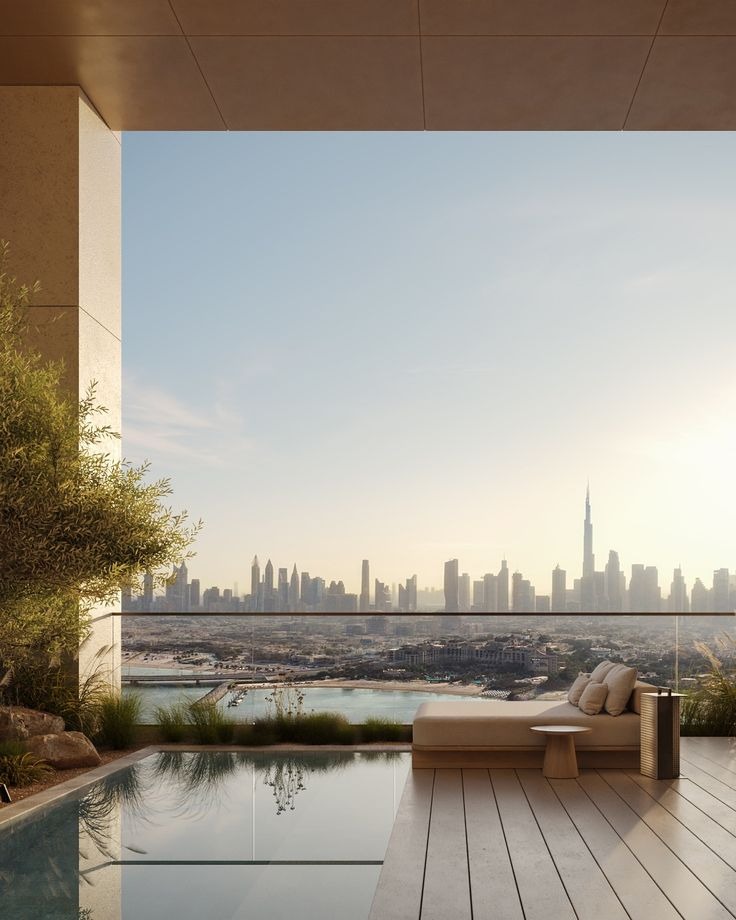
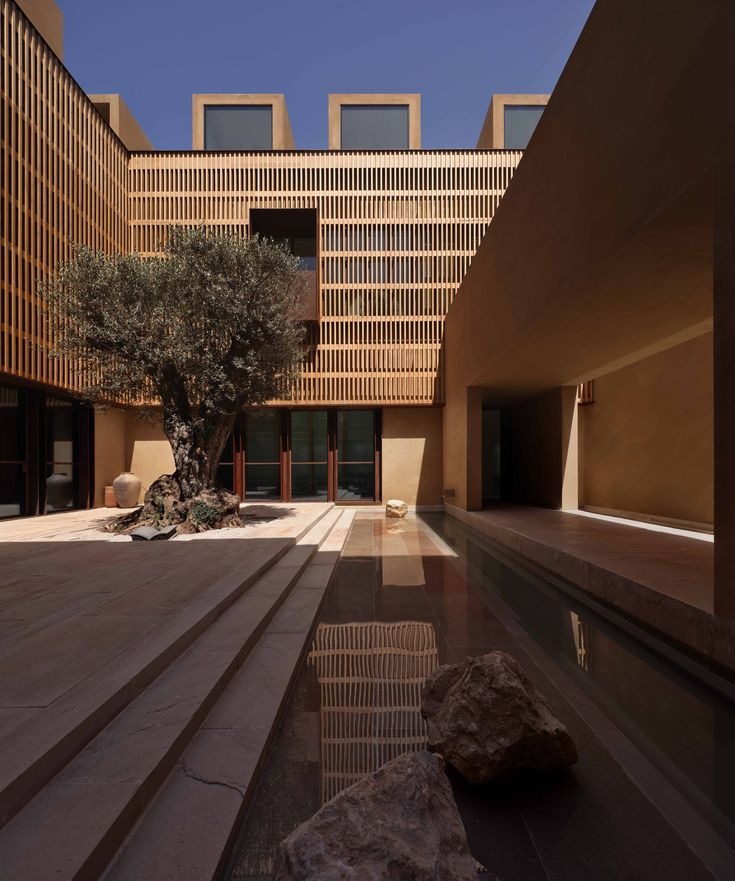
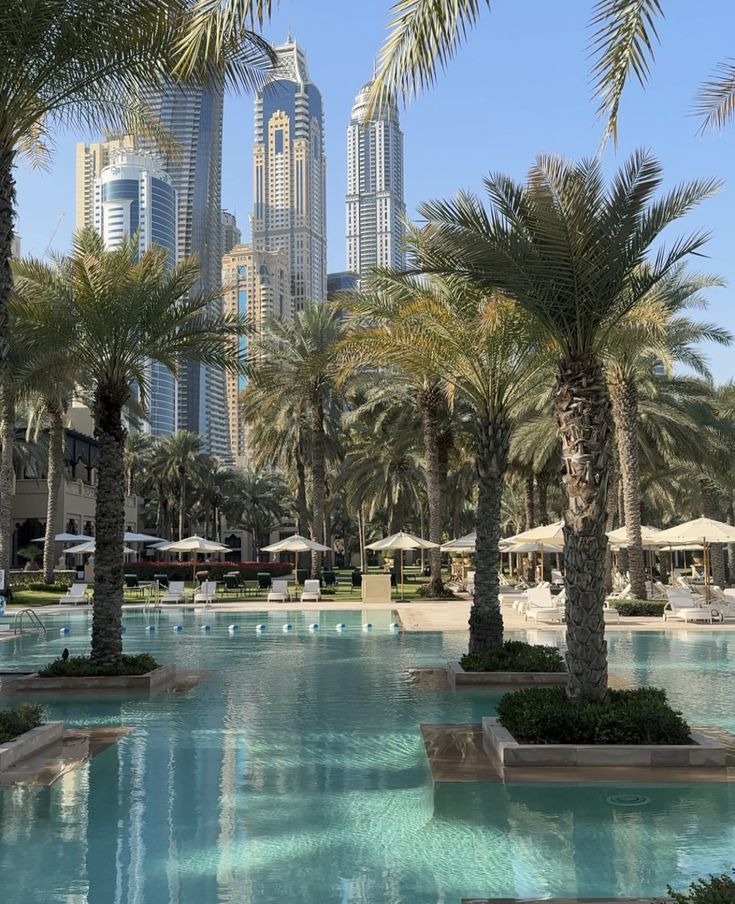
In the visual language of Dubai's luxury real estate, the formula is instantly recognisable. Warm stone. Shaded courtyards. Palm trees. Still water. Skyline views. Infinity pools. Sculptural balconies. Soft beige façades glowing in the desert light. Every image seems to promise the same thing: privacy, success, calm and proximity to the future.
Dubai real estate is not sold merely as property. It is sold as arrival.
That is also why the current market deserves a more critical reading. When a city becomes this good at selling aspiration, the line between real value and inflated expectation can become dangerously thin.
Over the past five years, Dubai's residential market has experienced an extraordinary boom. Metropolitan Real Estate reported 200,814 residential transactions in 2025, with a total value of AED 543.9 billion. Engel & Völkers described 2025 as one of Dubai's strongest years on record, with 202,349 residential transactions worth AED 546.8 billion. Knight Frank also reported record residential activity in 2025, with 205,400 transactions and AED 544.2 billion in total sales value (Metropolitan Real Estate, 2026; Engel & Völkers Middle East, 2026; Knight Frank, 2026).
On the surface, these figures tell a story of confidence, capital and global demand. But record-breaking markets are often at their most dangerous when they look strongest.
Dubai real estate is not sold merely as property. It is sold as arrival.
A Boom Built on Real Strength
To describe Dubai's real estate market as a bubble does not mean that everything is fake. That would be too simple.
Dubai has real advantages. It has no personal income tax, a powerful tourism sector, a growing population, an internationally connected airport, political stability relative to many surrounding markets, and a business environment that continues to attract entrepreneurs, investors and wealthy migrants.
The official figures support this story of growth. The Dubai Land Department's real estate data gives investors, analysts and developers a constant stream of transaction information, while its Annual Report: Real Estate Sector Performance 2024 presents the emirate as a rapidly expanding market with data on transaction activity, price movements and investment behaviour (Dubai Land Department, n.d.; Dubai Land Department, 2025).
This matters because Dubai's boom is not imaginary. It is not based purely on marketing brochures or social media videos. Real homes are being sold. Real money is entering the market. Real buyers are moving to the city.
But real demand does not eliminate bubble risk.
Most bubbles begin with a strong underlying story. The problem usually starts when that story becomes exaggerated. Prices rise. Buyers fear missing out. Developers launch more aggressively. Agents multiply. Investors convince themselves that the market has entered a permanently higher phase.
Dubai has been here before. The Financial Times reported that Dubai's property rally was closing in on pre-2008 record levels, after a strong post-pandemic bull run that invited comparisons with previous boom-bust cycles (Financial Times, 2025). The comparison is not perfect. Dubai today is more mature, better regulated and more globally established than it was before the 2008 crash. But the psychology of real estate cycles has not disappeared.
In every boom, people eventually start saying: this time is different. Sometimes, they are partly right. Rarely are they completely right.
The Majlis Newsletter
Continue reading with us. New essays on markets, pipelines and capital, delivered as they publish.
The Luxury Market and the Illusion of Scarcity
One of the most striking features of Dubai's current cycle is the strength of its luxury and prime residential market.
Savills reported that Dubai's prime residential segment experienced a tenfold increase in activity between 2020 and 2024, rising from 469 transactions to 4,670. In Q1 2025 alone, more than 1,300 units above AED 10 million were sold, a 31% year-on-year increase. Knight Frank's Q4 2025 review tells a similar story: prime values accelerated sharply, and the ultra-luxury segment remained robust, with 500 sales above US$10 million in 2025 (Savills, 2025; Knight Frank, 2026).
This is where Dubai's real estate market becomes especially interesting. In traditional luxury markets such as London, Paris or New York, scarcity is often historic. There is only one Mayfair, one Saint-Germain, one Upper East Side. Supply is constrained by history, planning law, heritage protection and geography.
Dubai manufactures scarcity differently.
It creates scarcity through branding, master-planning and lifestyle design. Palm Jumeirah, Downtown Dubai, Business Bay, Dubai Marina, Jumeirah, Dubai Hills and emerging coastal enclaves are not just locations. They are identities. They tell buyers not only where they live, but what kind of person they have become.
In that sense, Dubai does not simply build buildings. It builds status systems. And status systems can be incredibly profitable until too many people are sold the same version of exclusivity.
The Aesthetic Machine Behind Dubai Real Estate
The photographs selected for this article say a lot about where Dubai's real estate identity is heading.
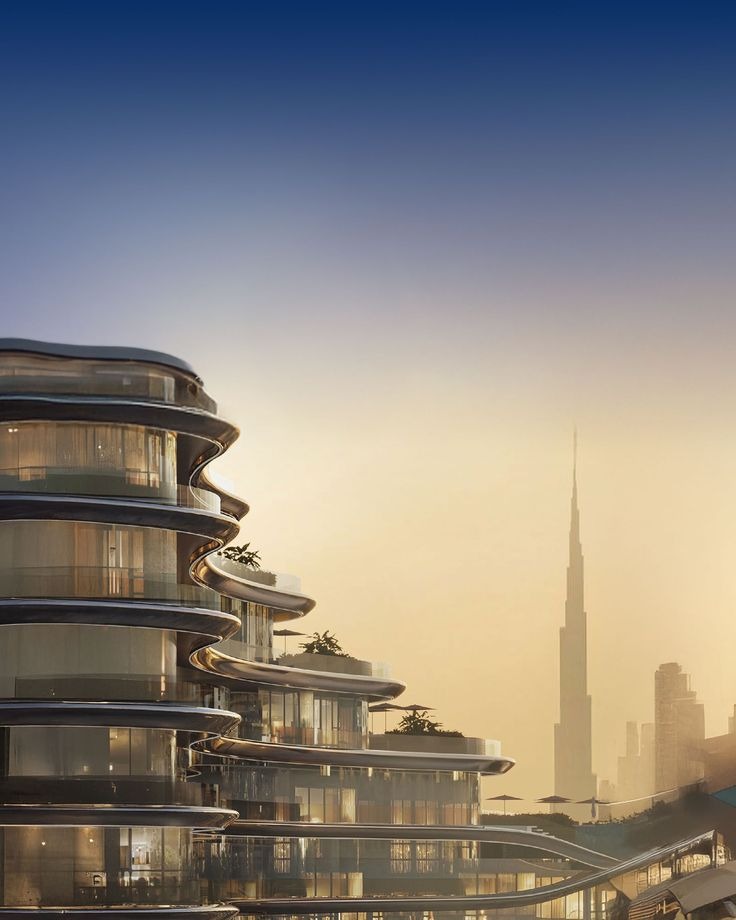
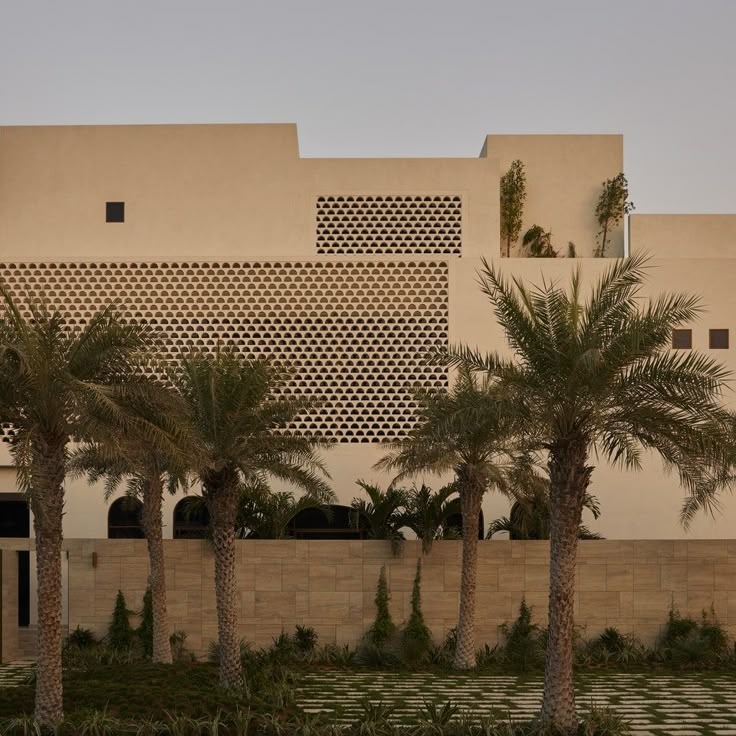
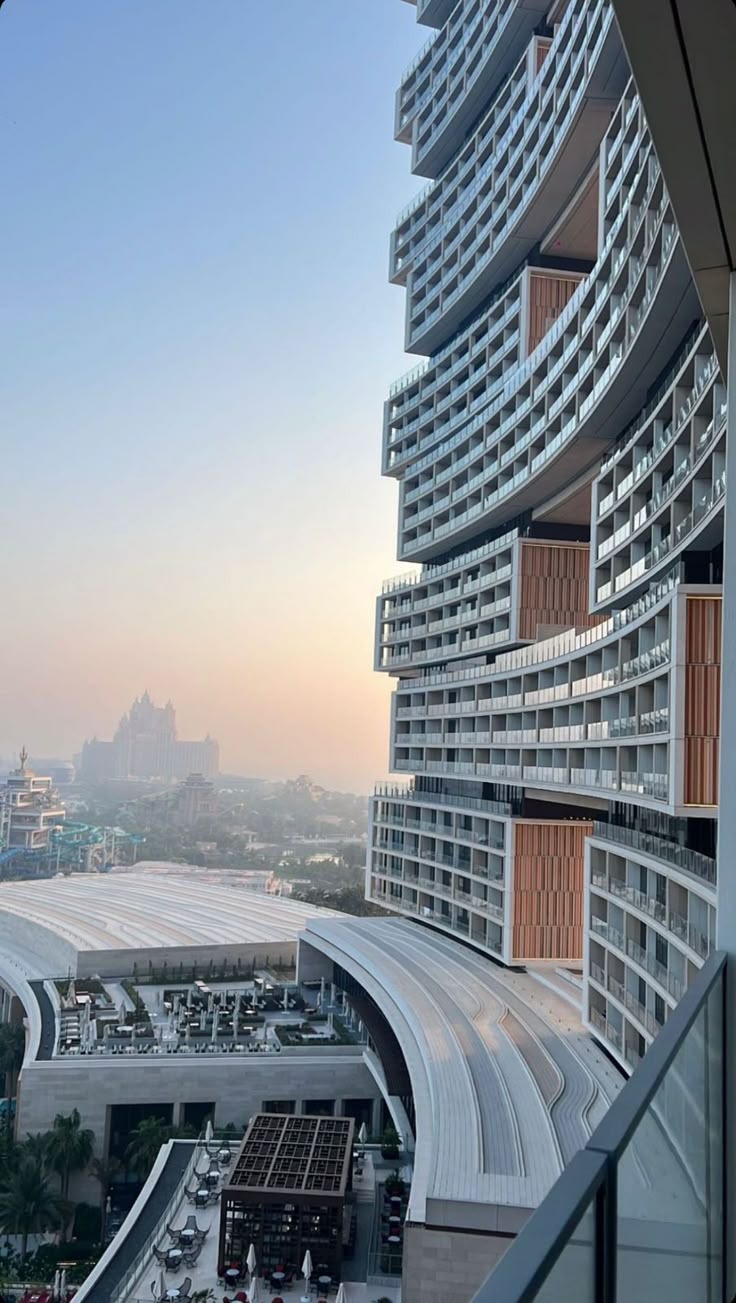
This is no longer only the Dubai of cold glass towers and record-breaking height. The newer luxury aesthetic is softer, warmer and more controlled. It uses desert tones, natural materials, shaded terraces, carved screens, water features, palm trees and sculptural architecture to create a feeling of calm in a climate and city defined by intensity.
One image shows a courtyard with an old tree, warm stone, timber screens and a narrow reflecting pool. It feels almost monastic. Another shows a beige façade with rhythmic geometric openings, softened by palms and landscaped greenery. Another places the viewer on a private terrace, with a pool in the foreground and the Burj Khalifa in the distance. The remaining images show curved balconies, sunset light and the kind of architectural softness that makes high-density luxury feel intimate.
This visual language is not accidental. It sells three things at once: nature, privacy and dominance. The buyer is offered greenery without disorder, water without risk, city views without noise, and urban energy without inconvenience. It is the fantasy of being above the city while still owning a piece of it.
Dubai's broader urban ecosystem reinforces that fantasy. The city welcomed 18.72 million international overnight visitors in 2024, according to the Dubai Department of Economy and Tourism, surpassing its previous annual record (Dubai Department of Economy and Tourism, 2025). Tourism does not only fill hotels. It strengthens the city's image as a global lifestyle destination, which in turn supports demand for short-term rentals, branded residences and investment properties.
Retail plays the same role. Dubai Mall reportedly welcomed more than 111 million visitors in 2024, while Mall of the Emirates announced a landmark AED 5 billion transformation into a next-generation lifestyle destination (Time Out Dubai, 2025; Majid Al Futtaim, 2025). These malls are not just shopping centres. They are part of the property machine.
Dubai Design District adds another layer to the same story. It positions creativity, fashion, premium real estate, restaurants and design studios within a single lifestyle environment, helping the city move from a place of construction to a place of curated taste (Dubai Design District, n.d.).
That is the strength of Dubai. It is also the risk. When real estate value becomes deeply tied to lifestyle imagery, investor psychology can become detached from ordinary fundamentals.
The buyer is offered greenery without disorder, water without risk, and skyline views without noise.
Reality TV and the New Dubai Mythology
Dubai's luxury culture is no longer only experienced by those who live there. It is consumed globally.
Netflix's Dubai Bling invites viewers into a world of private jets, lavish parties, skyline views and extravagant fashion. Netflix describes the show as a look inside a high-flying social circle where lavish parties, stunning skylines and fashion are the norm. Peacock describes The Real Housewives of Dubai as following women navigating relationships, careers and ultra-wealthy lifestyles in the United Arab Emirates (Netflix, n.d.; Peacock, n.d.).
This kind of media matters because it does not simply reflect Dubai's image. It amplifies it.
Reality TV turns Dubai into a global theatre of wealth. The city becomes a place where success is visible, where reinvention seems possible, and where identity can be performed through penthouses, fashion, cars, parties and skyline views.
The rise of shows such as Dubai Bling and Desi Bling also reveals something deeper about how quickly Dubai's lifestyle culture has changed. In less than a decade, the city's global image has shifted from business hub and luxury travel destination to a full-blown social media and reality-TV ecosystem. Wealth in Dubai is not only accumulated. It is displayed, filmed, edited and distributed.
Coverage of Desi Bling cast member Rizwan Sajan, founder of the Dubai-based Danube Group, turns a real estate business story into a rags-to-riches mythology: from modest beginnings in Mumbai to a multibillion-dollar Dubai empire (Hindustan Times, 2026). Stories like this are compelling because they combine entrepreneurship, migration, luxury and real estate into one seductive message: Dubai is where ambition becomes visible.
For some buyers, Dubai is not simply a place to live or invest. It is a personal rebrand. A move to Dubai can signal success, tax optimisation, global mobility, luxury consumption and proximity to a world that social media has made desirable.
But this creates a dangerous feedback loop. Real estate prices rise because Dubai appears desirable. Dubai appears more desirable because prices rise, celebrities move there, influencers film there, and reality TV turns the city into a spectacle of wealth. The more expensive it becomes, the more exclusive it appears. The more exclusive it appears, the more people want in. Until the image becomes heavier than the fundamentals beneath it.
The Off-Plan Engine
Another key risk is the dominance of off-plan sales.
Off-plan property is central to Dubai's growth model. It allows developers to finance projects through staged payments, gives buyers access to lower entry prices, and creates a speculative market where investors can buy future units with the expectation that values will rise before completion.
In a rising market, this can work extremely well. But it also increases fragility.
Metropolitan Real Estate reported that off-plan activity dominated the 2025 residential market, while other market analyses also point to off-plan transactions making up a very high share of total activity (Metropolitan Real Estate, 2026). This does not automatically mean the market is unhealthy. Off-plan sales are normal in Dubai. The city has long relied on development pipelines and future delivery as part of its real estate model.
The concern is scale.
When such a large share of activity is tied to projects that have not yet been completed, the market becomes more dependent on confidence. Buyers need to believe that developers will deliver, that demand will remain strong, that rents will support yields, and that resale values will hold up when units are handed over.
If confidence weakens, off-plan markets can change quickly. Investors who once expected to flip before completion may suddenly find fewer buyers. Landlords may face more competition from newly delivered units. Developers may offer incentives. Sellers may become more flexible. What looked like unstoppable growth can become a crowded exit.
The Supply Wave Nobody Can Ignore
The clearest warning sign is future supply.
Real Estate Club Dubai has warned of a major 2026–2027 delivery wave, with more than 100,000 residential units scheduled for 2026 and another 75,000 in 2027. The same source identifies supply concentration in areas such as Jumeirah Village Circle, Business Bay, Dubai South, Mohammed Bin Rashid City and Dubailand, where oversupply risk may be more pronounced (Real Estate Club Dubai, 2026).
This is not a small detail. Supply is where real estate dreams meet reality.
A luxury brochure can sell scarcity. A skyline render can sell exclusivity. A payment plan can sell accessibility. But once thousands of units are delivered, the market has to absorb them.
That absorption depends on real residents, real tenants, real incomes and real long-term demand.
The Times of India, citing UBS, reported that the UAE real estate sector entered 2026 from a strong position, supported by robust demand and strong developer backlogs, but also warned that Dubai is beginning to face oversupply pressure (The Times of India, 2026).
This distinction matters. The UAE may remain structurally attractive while specific parts of Dubai become oversupplied. Prime villas on scarce waterfront plots may behave very differently from investor apartments in heavily supplied districts. The market is not one single thing.
That is why the bubble question should not be framed as: Will all Dubai real estate crash? A better question is: Which parts of Dubai are priced for perfection, and which areas have enough real demand to survive the next supply wave?
Supply is where real estate dreams meet reality.
Cooling Signs Are Already Appearing
The first signs of cooling are visible.
The Economic Times recently reported that Dubai's residential property market is cooling after a five-year rally. Buyers are becoming more price-sensitive, negotiating harder and shifting toward smaller, lower-cost homes, while higher supply and geopolitical uncertainty weigh on sentiment. The article also noted that annual growth has slowed sharply from the stronger levels seen in 2024 (The Economic Times, 2026).
This is often how overheated markets turn. Not with an immediate crash. Not with panic on day one. But with hesitation.
Buyers pause. Agents become more flexible. Developers offer incentives. Investors start comparing yields more carefully. Transactions slow in certain segments. Sellers who expected easy gains begin to realise that the market is no longer moving only in one direction.
The danger is not necessarily that Dubai collapses overnight. The more realistic risk is a multi-speed correction. Prime assets may hold up better. Well-located, completed properties with strong rental demand may remain resilient. But oversupplied off-plan-heavy areas could face rent pressure, resale pressure and weaker capital appreciation.
In that scenario, the headline market may still look respectable while many individual investors experience disappointment. The skyline remains beautiful. The marketing continues. The city keeps growing. But the late buyer who paid too much in the wrong area may still lose money.
The “This Time Is Different” Argument
To be fair, there are strong arguments in Dubai's favour.
Dubai today is not the Dubai of 2008. The market is more transparent. Regulation has improved. The buyer base is more international. The city has become a genuine destination for entrepreneurs, remote workers, family offices, wealthy migrants and multinational businesses.
Its infrastructure is world-class. Its tax regime remains attractive. Its lifestyle appeal is real. Its tourism machine is powerful. Its luxury positioning is not just marketing; much of it has been physically built.
That is why it would be lazy to say that Dubai is simply a bubble waiting to burst.
The more interesting argument is that Dubai may be both: a structurally successful city and an overheated property market. Those two things can exist at the same time.
New York can be a great city and still have overpriced condos. London can remain a global capital while certain luxury developments underperform. Miami can benefit from wealth migration while still experiencing speculative excess. Dubai is no different.
The city's long-term story may remain intact, while parts of its real estate market become vulnerable to oversupply, inflated expectations and changing investor sentiment.
Conclusion: The Dream Is Real, But So Is the Risk
Dubai's real estate market is powerful because it combines fundamentals with fantasy.
The fundamentals are clear: population growth, tourism, global connectivity, tax efficiency, business migration, luxury infrastructure and strong international demand. The official data from Dubai Land Department, together with reports from Knight Frank, Engel & Völkers, Metropolitan Real Estate and Savills, shows that the market has achieved extraordinary scale and momentum (Dubai Land Department, n.d.; Engel & Völkers Middle East, 2026; Knight Frank, 2026; Metropolitan Real Estate, 2026; Savills, 2025).
But the fantasy is just as important.
Dubai sells more than homes. It sells identity. It sells reinvention. It sells the image of a life lived above ordinary limits: the skyline terrace, the palm-lined entrance, the private pool, the luxury mall, the reality-TV dinner party, the branded residence, the feeling that the future has already arrived and that you can own a piece of it.
That is what makes the market so attractive. It is also what makes it vulnerable.
The city's aesthetic appeal, luxury ecosystem and media-driven mythology have helped attract a wave of global capital. Yet the same forces can push buyers to overpay, underestimate risk and confuse lifestyle desire with investment discipline. Add a major 2026–2027 supply wave, heavy off-plan activity, signs of cooling demand and memories of previous boom-bust cycles, and the picture becomes more complicated.
Dubai is not a mirage. The city is real. The wealth is real. The demand is real. The transformation is real. But real markets can still become overheated.
And perhaps that is the central tension behind Dubai's property boom: the dream may be genuine, but the price of entering it may already assume that the dream never ends.
The dream may be genuine, but the price of entering it may already assume that the dream never ends.
References
- Bravo. (n.d.). The Real Housewives of Dubai. https://www.bravotv.com/the-real-housewives-of-dubai
- Dubai Department of Economy and Tourism. (2025, February 9). Dubai welcomes 18.72 million international visitors in 2024. https://www.dubaidet.gov.ae/en/newsroom/press-releases/dubai-international-visitors-2024
- Dubai Design District. (n.d.). Dubai Design District. https://design-district.ae/
- Dubai Land Department. (n.d.). Real estate data. https://dubailand.gov.ae/en/open-data/real-estate-data/
- Dubai Land Department. (2025). Annual report: Real estate sector performance 2024. https://dubailand.gov.ae/en/open-data/research/annual-report-real-estate-sector-performance-2024/
- Engel & Völkers Middle East. (2026). Dubai Residential Market Report 2025. https://www.engelvoelkers.com/ae/en/research/residential-market-report-fy-2025
- Financial Times. (2025, January 22). Dubai property rally closes in on pre-2008 record. https://www.ft.com/
- Hindustan Times. (2026). How Desi Bling's Rizwan Sajan went from Mumbai slums to a $2.5 billion fortune. https://www.hindustantimes.com/
- Knight Frank. (2026). Dubai Residential Market Review Q4 2025. https://www.knightfrank.ae/site-assets/pdf/dubai-residential-market-review-q4-2025.pdf
- Majid Al Futtaim. (2025, April 16). AED 5 billion transformation of Mall of the Emirates. https://www.majidalfuttaim.com/
- Metropolitan Real Estate. (2026). Dubai Residential Real Estate Market Report 2025. https://metropolitan.realestate/blog/dubai-residential-market-report-2025/
- Netflix. (n.d.). Dubai Bling. https://www.netflix.com/title/81462121
- Peacock. (n.d.). The Real Housewives of Dubai. https://www.peacocktv.com/
- Real Estate Club Dubai. (2026). The 2026–2027 delivery wave: Which Dubai areas face oversupply risk. https://realestateclubdubai.com/blog/market-analysis/the-2026-2027-delivery-wave-which-dubai-areas-face-oversupply-risk-and-where-the-bargains-are
- Savills. (2025, June 18). Dubai Prime Residential Report 2025. https://dubai.savills.ae/research_articles/244449/378148-0
- The Economic Times. (2026). Dubai's housing market cools after long red-hot five-year rally. https://economictimes.indiatimes.com/nri/invest/dubais-housing-market-cools-after-long-red-hot-five-year-rally/articleshow/132002667.cms
- The Times of India. (2026). UAE real estate kicks off 2026 strong, but Dubai faces oversupply pressure: Report. https://timesofindia.indiatimes.com/real-estate/news/uae-real-estate-kicks-off-2026-strong-but-dubai-faces-oversupply-pressure-report/articleshow/129731736.cms
- Time Out Dubai. (2025). 111 million visitors at Dubai Mall in 2024. https://www.timeoutdubai.com/news/dubai-mall-record-visitors
© 2026 House of Majlis. All rights reserved.
Back to the archive